

Compressor Spec Sheets Explained
Choosing a new air compressor is a big decision for any business. The specification sheet is the most useful tool you have, whether you run a pharmaceutical lab in Swindon or a manufacturing plant in Cardiff. It has all the information you need to match the equipment to your production needs, which makes sure it works reliably and uses less energy.
But it can be hard to understand these papers. Spec sheets have a lot of technical acronyms and different standards that can be hard to understand, even for the most experienced engineers. You could end up with equipment that is too small, production downtime, or energy bills that are higher than you thought if you read just one piece of data wrong, like flow rate or pressure.
This guide will show you how to properly read a compressor specification sheet. By knowing the most important metrics, you can make sure that your system is compliant, works well, and is the right size for your needs.
What Is the Difference Between Displacement and Free Air Delivery?
The difference between “piston displacement” and “Free Air Delivery” (FAD) is the most common thing that people get wrong on a spec sheet. While both measure air volume, they represent very different things.
Displacement Explained
Displacement is a theoretical figure. It works out how much air the compressor’s rotors or pistons could move if the whole thing worked perfectly. It doesn’t take into account the normal losses that happen inside the machine, like air leaking past seals or pressure drops across intake filters. Because of this, using the displacement number to size a system can lead to it being too small by 20 to 40 percent.
Free Air Delivery (FAD) Explained
Free Air Delivery (FAD) is the figure you should use for sizing. This measures the actual volume of usable air leaving the compressor package. FAD numbers are “expanded” back to ambient inlet conditions, which means they tell you exactly how much air your tools and machines can use.
Check for flow rates that have been tested according to ISO 1217 to make sure they are correct. This standard provides a verified method for measuring performance. Annex C of the standard covers fixed-speed compressors, while Annex E covers Variable Speed Drive (VSD) models, validating their efficiency across different speeds.
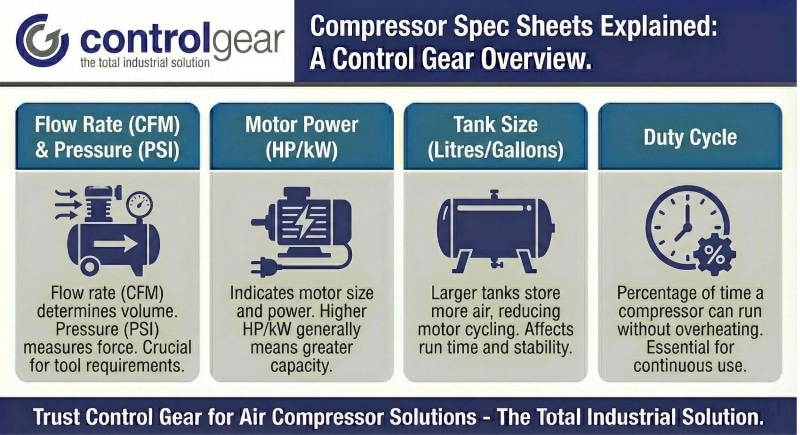
Understanding Flow Units
In the UK, you will encounter a mix of measurement units. Understanding how they relate helps when comparing different brands.
- l/s (Litres per second): This is the standard scientific unit used for precise system calculations.
- CFM (Cubic Feet per Minute): This is commonly used to rate pneumatic tools. As a rule of thumb, 1 l/s is approximately 2.12 CFM.
- m³/min (Cubic Metres per Minute): This is often seen on spec sheets for larger industrial compressors.
For more details on these metrics, you can read our guide on the difference between CFM and PSI in air compressors.
How Do Pressure Ratings Affect Performance?
Pressure and flow share an inverse relationship. Generally, as the pressure requirement increases, the volume of air (FAD) that the compressor can deliver decreases.
Gauge vs. Absolute Pressure
Specification sheets in the UK typically use bar(e), or effective gauge pressure. You can see this on a normal pressure gauge; it shows the pressure in relation to the local atmosphere. Sometimes, technical documents will show bar(a), or absolute pressure, which is the gauge reading plus the pressure of the air. It is important to ensure you are matching the compressor’s bar(e) rating to the requirements of your equipment.
The Risk of Over-Compression
It is often tempting to choose a higher pressure rating “just in case.” However, running a compressor rated for 13 bar when your facility only requires 7 bar is inefficient. The internal components of the compressor are optimised for their rated pressure. Operating them at a lower pressure can result in “over-compression” inside the element, which wastes energy.
Additionally, modern VSD compressors, such as the Atlas Copco GA VSD+, offer excellent pressure stability. While a fixed-speed unit might fluctuate by 1 bar between loading and unloading, a VSD unit holds pressure to within ±0.1 bar. This stability allows you to set a lower system pressure, reducing overall energy consumption.
For more on this topic, see our article on how correct sizing saves energy and money.
Why Is Specific Energy Requirement More Important Than Motor Power?
You can’t just look at a motor’s horsepower or kilowatt (kW) rating to see how well it works. Only the main motor shaft can use this “nominal power.” Other parts of the unit that use power, like cooling fans, controllers, and built-in dryers, do not.
Look for the Package Input Power to find out how much it really costs to run the machine. This figure represents the total electricity drawn from the grid by the entire unit.
Using SER to Compare Efficiency
The most accurate way to compare different compressors is by checking the Specific Energy Requirement (SER). This metric calculates how much power is needed to generate 1 m³/min of compressed air. A lower SER number indicates a more efficient machine.
Manufacturers like Atlas Copco also list the motor efficiency class.
- IE3: Premium efficiency, the current standard for induction motors.
- IE4: Super premium efficiency.
- IE5 / iPM: Ultra premium efficiency. Atlas Copco’s interior Permanent Magnet (iPM) motors are designed to maintain high efficiency even when running at low speeds, making them ideal for facilities with fluctuating demand.
How Does Duty Cycle Impact Compressor Selection?
The duty cycle shows you how long a compressor can run before it gets too hot. There is a big difference between these two technologies.
Rotary Screw Compressors
Rotary screw compressors, like the GA series, are designed for a 100 per cent duty cycle. They use fluid injection to actively cool the compression element, allowing them to run 24/7. This makes them the standard choice for manufacturing plants and industrial facilities.
Piston Compressors
Standard piston compressors rely on air cooling and typically have a duty cycle of 50 to 60 per cent. This means that they need “cool-down” times so that the cylinders can cool down. Running a piston compressor nonstop can cause it to overheat, which can break the valves or turn the oil into carbon.
Our guide on the different types of air compressors goes into great detail about how to choose the right one for your needs.
What Do ISO 8573-1 Air Quality Classes Mean?
For many businesses, especially those that make food, drinks, and medicines, clean air is very important. The ISO 8573-1 standard, which is a three-digit class string (for example, Class 1.4.1), will usually be used to show air quality on the spec sheet.
This breaks down as follows:
- Digit 1 (Solid Particles): This measures how effectively filters remove dust. Class 1 is very strict, filtering down to the 0.1–0.5 micron range.
- Digit 2 (Water): This refers to the Pressure Dew Point (PDP). Class 4 indicates a dew point of +3°C, which is standard for an integrated refrigerant dryer. Class 2 indicates -40°C, which requires a desiccant dryer.
- Digit 3 (Oil): This measures total oil content. Class 1 requires high-efficiency filtration (< 0.01 mg/m³).
Class 0 Air
Class 0 means that the air is 100% oil-free, which is the highest level of purity. The Atlas Copco Z-series is an example of a true Class 0 compressor. It doesn’t use oil in the compression chamber. This gets rid of the chance of oil contamination, which is very important for sensitive uses.
UK Regulatory and Environmental Considerations
Always keep in mind the local operating environment when reading specification sheets. In the UK, this means taking into account specific electrical and temperature factors.
Ambient Temperature Corrections
Most spec sheets say that performance is best at 20°C. But in the summer, plant rooms in the UK can easily get hotter than 30°C. When the temperature rises, the air becomes less dense, which affects how well the dryer works.
For example, a refrigerant dryer rated for a certain flow at 20°C will be less effective at 35°C. To compensate, engineers apply a “correction factor” found in the data sheet. Ignoring this can lead to the dryer becoming overwhelmed, resulting in condensate forming in your pipes.
PSSR 2000 Compliance
Safety is paramount. The Pressure Systems Safety Regulations (PSSR) 2000 require a Written Scheme of Examination (WSE) for systems that exceed a certain pressure-volume threshold (250 bar-litres). The spec sheet provides the receiver volume and pressure data needed to calculate this. Control Gear provides WSE generation and statutory inspections as part of our Total Industrial Solution.
Atlas Copco Features to Look For
When reading an Atlas Copco spec sheet, you will notice several proprietary features designed to improve reliability and control.
- Elektronikon®: This is the intelligent control system. It manages pressure bands and service timers, helping to optimise the motor’s performance.
- SMARTLINK: Often listed under connectivity, this feature transmits machine data to a remote dashboard. It allows for predictive maintenance, alerting you to potential issues before they cause downtime.
- VSD+ / VSDˢ: This designation indicates vertical drive train technology. These units are compact and highly efficient, often exceeding standard VSD performance.
Summary
Reading a compressor specification sheet correctly is the best way to protect your investment. By verifying the Free Air Delivery (FAD) to ISO 1217 standards, calculating the Specific Energy Requirement (SER), and accounting for ambient temperature corrections, you can select a system that delivers reliable, efficient performance.
At Control Gear, we apply these technical standards to every project. With over 50 years of experience serving South Wales and the West, from Swansea and Cardiff to Bristol and Swindon, we offer a Total Industrial Solution. This includes system design, installation, PSSR compliance, and energy audits.
To ensure your next compressor meets your exact specifications, contact our engineering team today.