A Guide to Air Compressor Pressure
Recent data reveals that running just 1 bar too high increases energy costs by 7%. Correct pressure settings determine the difference between an efficient system and a wasteful one. At Control Gear, we have spent over 50 years balancing pressure requirements for industrial sites.
As a premier Atlas Copco distributor, our engineers ensure your equipment operates within safe and efficient limits. This article explains pressure bands, safety regulations like PSSR 2000, and how to diagnose system drops.
What Is Air Compressor Pressure and How Is It Measured?
Air compressor pressure is the force per unit area applied to air within a confined system. It determines the potential power available to drive pneumatic tools. It is distinct from flow, which measures the volume of air moved over time.
In the UK, we mainly measure this force using bar(g). The ‘g’ denotes gauge pressure relative to atmospheric pressure. Most industrial sites rely on the metric unit bar, though you will often see gauges marked in PSI (Pounds per Square Inch).
The conversion is straightforward. 1 bar is around equal to 14.5 PSI. It is actually quite annoying that many older gauges we see on site still only show PSI. This forces us to do the mental maths every time we take a reading.
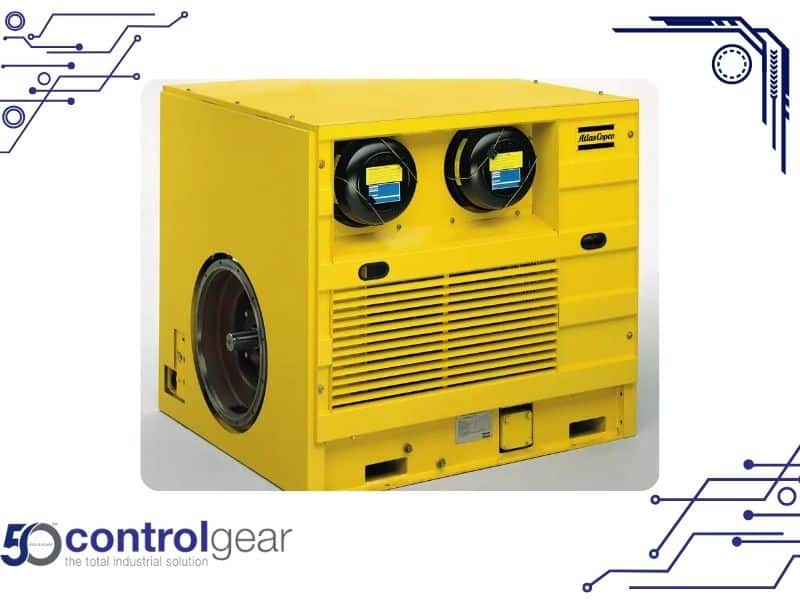
Our engineers at Control Gear use these metrics to design systems correctly. This ensures equipment like the Atlas Copco G Series, a standard industrial rotary screw compressor, operates efficiently. Different compressor technologies are designed for specific pressure bands.
| Compressor Type | Typical Pressure Range | Ideal Application |
| Rotary Screw | 7 bar – 13 bar | Continuous manufacturing |
| Piston | 8 bar – 30 bar | Intermittent workshop use |
How Does Excess Pressure Impact Your Energy Costs?
Running a compressor at a higher pressure than necessary directly increases electricity consumption. This follows a linear relationship known as the 7% Rule. For every 1 bar of excess pressure generated, your total energy bill rises by around 7%.
This inefficiency compounds quickly in industrial environments where compressors run continuously. It affects operations regardless of whether you operate single-stage vs two-stage equipment. High system pressure also creates Artificial Demand.
Artificial Demand occurs when unregulated tools consume more air volume than their specifications need. Understanding the difference between CFM and PSI clarifies why volume usage spikes alongside force. If a pneumatic drill is rated for 6 bar but fed 8 bar, it uses more air to perform the same work.
This forces your equipment to work harder to replace wasted volume. The financial impact is severe given the current UK energy prices. For a facility running a 75 kW compressor at 15p per kWh, that single bar of over-pressurisation adds thousands to annual overheads.
We identify these losses routinely during energy audits for our clients. Beyond energy bills, excess pressure accelerates wear across your system.
- Pneumatic Tools: Internal components degrade faster under higher stress.
- System Leaks: A 3mm hole loses 40% more air at 8 bar than at 6 bar.
- Seals and O-rings: Higher pressure increases the frequency of blowouts.
What Are the Most Common Causes of Pressure Drops?
Pressure drops occur when airflow encounters resistance from friction in piping, clogged components, or leaks within the distribution network. If you find your air compressor not building pressure, these restrictions are often the culprit. While some pressure loss is unavoidable due to physics, excessive drops are usually caused by poor system design.
We often find the worst offenders in the Dirty Thirty. This is the slang term for the final 30 feet of pipework leading to the tool. It is incredibly frustrating to see a high-spec system choked by a cheap 6mm coil hose.
Someone likely bought the hose from a local hardware shop just to save a few pounds. This section frequently relies on undersized hoses, restrictive quick couplers, and complex bends. These components choke flow immediately before the application.
They create a bottleneck that even the most powerful compressor can’t overcome. Unaddressed leaks are equally damaging to your bottom line. A single 3mm leak in a standard 7-bar system wastes around £1,000 annually in electricity.
Our engineers use professional leak detection services to locate these invisible wasters. Internal blockages also force the system to overcompensate. Common restriction points include:
- Saturated filter elements: Accumulated debris creates high differential pressure.
- Corroded carbon steel: Rust build-up narrows the internal pipe diameter.
- Sharp elbows: Poor layout adds unnecessary friction and turbulence.
Why Is Professional Maintenance Critical for UK Compliance?
Professional maintenance is mandatory under the Pressure Systems Safety Regulations (PSSR) (hse.gov.uk). These regulations require strict inspection schedules for all compressed air systems exceeding 250 bar-litres. Without a current Written Scheme of Examination (WSE) certified by a competent person, your plant insurance is effectively void.
We manage these statutory inspections to protect directors from prosecution. Non-compliance carries severe penalties, including unlimited fines and potential prison sentences. Compliance also extends strictly to air purity.
This is critical for food and pharmaceutical sectors requiring ISO 8573-1 Class 0 standards. A neglected dryer can allow moisture breakthrough. This risks ruining production batches and violating health codes.
Our Guardian Service Plan tracks these filtration metrics to prevent contamination risks before they impact your product line. Safety valves serve as your final defence against catastrophic vessel failure. We test these valves annually to confirm they lift at the correct set pressure, preventing dangerous over-pressurisation.
How Can Control Gear Optimise Your System Pressure?
Control Gear optimises your system pressure by deploying Atlas Copco VSD technology. This matches motor speed directly to air demand. It eliminates the fluctuations that force systems to run at artificially high pressures.
A stable pressure band reduces energy consumption significantly. Every 1 bar reduction saves 7% in energy costs. We focus on stabilising this baseline to prevent the waste associated with artificial demand.
We are a premier distributor for Atlas Copco, a global leader in compressed air solutions. We install Elektronikon controllers to centralise pressure management. This intelligent hardware monitors system performance in real-time to prevent pressure drift.
Hardware is only half the solution. Our Guardian Service Plan protects your investment through complete air compressor maintenance. This creates a worry-free ownership experience.
Our pressure optimisation support includes:
- 24/7 emergency support across South Wales and the West.
- Fixed-price servicing with no hidden costs.
- Strategies to lower Total Cost of Ownership (TCO).
Maintaining the correct pressure is key to lower your energy bills and stop costly equipment failure. Unchecked leaks and poor maintenance are often the real enemies of efficiency.
Contact our engineering team in Pontypridd or Newton Abbot today to arrange a system audit, which includes complete data logging and leak detection, ensuring your pressure actively supports your production targets.