
Air Compressors Explained: Single-Stage vs Two-Stage
Choosing the right air compressor is an important engineering choice. Not just horsepower, but also your pressure needs, duty cycle, and thermodynamic efficiency.
For UK facilities, from automotive garages to manufacturing plants, the choice between single-stage and two-stage reciprocating technology determines your operational capability. It also impacts your regulatory compliance.
This guide talks about the technical differences, performance metrics, and legal issues that each system has. It is meant to help you choose the right tools for you.
For UK businesses, from automotive garages to advanced manufacturing plants, choosing between single-stage and two-stage air compressor technology significantly impacts operational efficiency and regulatory compliance.
This comprehensive guide dives into the technical specifications, performance metrics, and legal considerations of both single-stage and two-stage air compressors, empowering you to make the right choice for your needs.
What is the Fundamental Difference Between Single and Two-Stage Compressors?
The main difference is how many times the air gets squished between the inlet valve and the discharge nozzle.
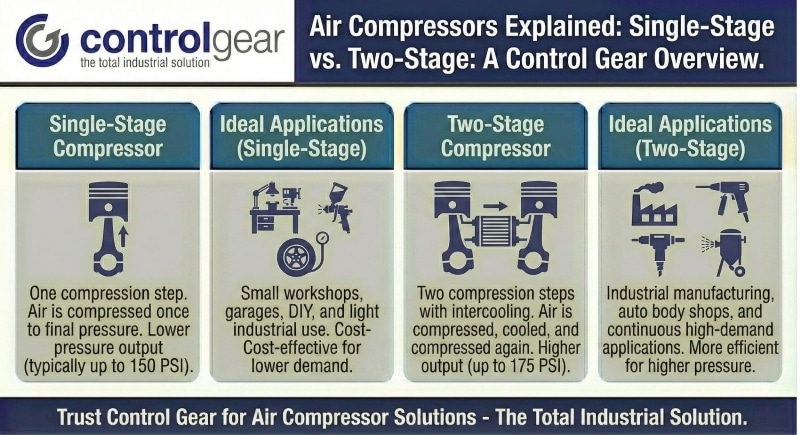
The fundamental difference between single-stage air compressors and two-stage air compressors lies in the number of compression cycles used to reach the desired pressure. A single-stage compressor achieves the final pressure in one compression stroke, while a two-stage compressor uses two stages to compress the air gradually.
Single-Stage Compression
A single-stage piston compressor compresses air from ambient pressure to the final discharge pressure in a single stroke.
- Process: Air enters the cylinder. It is compressed to approximately 7–10 bar (115–145 psi) and discharged directly into the receiver tank.
- Thermal Byproduct: This rapid compression generates significant heat. Discharge temperatures commonly range between 120°C and 150°C.
- Efficiency: High thermal loads reduce volumetric efficiency. This makes these units suitable primarily for intermittent duty rather than continuous running.
A single-stage compressor compresses air in a single stroke. Air enters the cylinder, is compressed to around 7-10 bar (115-145 psi), and then discharged into the air receiver. This process generates significant heat, leading to discharge temperatures between 120°C and 150°C. Due to these high thermal loads, single-stage compressors are best suited for intermittent use.
Two-Stage Compression
A two-stage compressor splits the work into two distinct steps. This manages heat generation and improves overall efficiency. It is mechanically distinguishable by having cylinders of unequal size.
- Process: The first, larger low-pressure (LP) piston compresses air to an intermediate pressure (~2.5–4 bar). This air goes through an intercooler, which cools it down. Finally, it goes into the second, smaller high-pressure (HP) piston, where it is compressed to the final discharge pressure (10–30 bar).
- Thermodynamics: Cooling the air between stages allows the process to more closely approach isothermal compression.
- Why This Matters: Because cooled air is denser, the second stage demands less effort. Practically speaking, this indicates that, given identical motor power, it displaces air 15–20% more efficiently than a single-stage unit. Consequently, the valve exhibits an extended lifespan, reduced operating temperatures, and decreased electricity expenses per cubic metre.
A two-stage compressor divides the compression into two steps to manage heat and boost efficiency. The first, larger piston compresses air to an intermediate pressure (~2.5–4 bar). The air then passes through an intercooler to reduce its temperature before entering the second, smaller piston, where it’s compressed to the final pressure (10–30 bar).
This intercooling allows the process to approach isothermal compression, making the second stage more efficient. With the same motor power, a two-stage unit can displace air 15-20% more efficiently than a single-stage model, extending valve life, lowering operating temperatures, and reducing electricity costs.
When is a Single-Stage Compressor Sufficient?
A single-stage compressor is often sufficient for various applications where air demand is intermittent and pressure requirements are below 10 bar. These air compressors are suitable for general workshops, framing and construction, and light commercial tasks where cooling time between cycles is ample.
Target Applications:
- General Workshops: Powering impact wrenches, ratchet guns, and blowguns that operate at 90 psi (6.2 bar).
- Framing and Construction: Portable units for nail guns.
- Light Commercial: Applications where the compressor has ample time to cool down between cycles.
Attributes:
- Pressure Limit: Operates efficiently up to 8–10 bar.
- Cost: Lower initial Capital Expenditure (CAPEX).
- Duty Cycle: Typically limited to around 50–60% duty cycle. This depends on ambient temperature and cooling capacity.
Why Require a Two-Stage Compressor?
When applications demand pressures above 10 bar or require continuous industrial reliability, two-stage technology is the preferred choice. These air compressors are essential for heavy-duty automotive tasks, industrial manufacturing processes needing consistent 15–30 bar output, and continuous production applications like sandblasting or spray painting.
Target Applications:
- Heavy Duty Automotive: Truck (HGV) and bus tyre inflation requires pressures exceeding 150 psi (10 bar). Single-stage units cannot safely sustain this.
- Industrial Manufacturing: Processes requiring consistent 15–30 bar output.
- Continuous Production: Applications like sandblasting or spray painting. Here, airflow demand is continuous and stable pressure is critical.
Attributes:
- Pressure Capability: Standard two-stage units deliver 12–15 bar. Specialised high-pressure units can achieve 30 bar.
- Duty Cycle: Industrial two-stage units are often rated for 100% duty cycle.
- RPM: These units typically operate at lower RPM. This reduces vibration and extends component life.
- Energy Efficiency: Delivers more CFM and PSI per kW of electricity consumed.
Which Atlas Copco Range Fits My Application?
Control Gear supplies three distinct tiers of piston technology. Each is engineered for specific operational profiles.
1. The Automan Range (Light Commercial)
- Configuration: Belt-driven, aluminium block.
- Stage Type: Available in both single-stage and smaller two-stage versions.
- Use Case: Ideal for mobile mechanics and small workshops with standard power supplies.
2. The LE Range (Industrial Single-Stage)
- Configuration: Direct-drive (no belt transmission losses), V-layout.
- Stage Type: Single-stage industrial.
- Use Case: Facilities needing 10 bar air with high durability. The direct-drive motor runs at lower RPM. This significantly extends bearing life compared to belt-driven alternatives.
3. The LT Range (Industrial Two-Stage)
- Configuration: Direct-drive, V-layout with intercooler.
- Stage Type: Two-stage heavy industrial.
- Use Case: The premier choice for high-pressure applications (15–30 bar). These units feature stainless steel valves rated for over 16,000 running hours. They are designed for heavy-duty cycles that would cause lesser machines to fail.
Control Gear offers three distinct tiers of piston compressors, each engineered for specific operational needs.
To compare these against other technologies, such as rotary screws, review our guide on Different types of air compressor.
How Does the PSSR 2000 Regulation Affect My Choice?
When upgrading to a two-stage compressor, the system’s pressure typically increases. This is significant as it may give rise to specific legal obligations under the Pressure Systems Safety Regulations (PSSR 2000).
The 250 Bar-Litre Threshold
In the UK, strict rules apply to any system containing a relevant fluid (compressed air). A Written Scheme of Examination (WSE) is needed if the pressure times the internal volume is 250 bar-litres or more.
The Calculation:
Pressure (bar) × Volume (litres) = Bar-Litres
Comparison Examples
- Small Single-Stage: A 24-litre receiver operating at 8 bar.
24 × 8 = 192 bar-litres
Status: Below the threshold. A WSE is not mandatory (though PUWER safety rules still apply). - Standard Two-Stage: A 50-litre receiver operating at 11 bar.
50 × 11 = 550 bar-litres
Status: Significantly above the threshold. A WSE drawn up by a “Competent Person” is a legal requirement before operation.
Important Note: Operating a system over 250 bar-litres without a valid Written Scheme of Examination may invalidate insurance. It is also a breach of the Pressure Systems Safety Regulations.
Control Gear engineers can assist in calculating these values. We provide the necessary statutory inspections to ensure your facility remains compliant.
Upgrading to a two-stage compressor often increases system pressure, potentially triggering obligations under the Pressure Systems Safety Regulations (PSSR 2000) (hse.gov.uk). In the UK, systems containing compressed air must adhere to strict rules. A Written Scheme of Examination (WSE) is required if the pressure multiplied by the internal volume equals or exceeds 250 bar-litres.
What Are the Electrical Infrastructure Requirements?
Moving from single to two-stage compression frequently necessitates an upgrade in electrical supply.
Single-Phase Constraints (230V)
Standard UK 3-pin or “blue plug” supplies are generally limited to motors under 3 kW (approx. 4 hp).
- Most single-stage compressors are made to work in this range.
- Start/run capacitors are what single-phase motors need. These are common place for things to go wrong when there is a lot of weight or a lot of cycling.
Three-Phase Requirements (400V)
Most two-stage compressors, especially the industrial LT series, need motors that can handle 4 kW (5.5 hp) or more. This is needed to make high pressures work well.
- Requirement: A 400V three-phase supply is essential.
- Benefit: Three-phase motors provide smoother torque and lower amp draw per phase. They offer higher reliability due to the absence of starting capacitors.
Switching from single-stage to two-stage compression often requires upgrading the electrical supply. Standard UK 3-pin supplies typically limit motors to under 3 kW (approx. 4 hp), which most single-stage compressors are designed to work within.
How Does Total Cost of Ownership Compare?
Industrial users often find that the long-term costs of running a two-stage unit are lower, even though the purchase price is higher.
- Energy Consumption: Two-stage units approach isothermal compression. This means they require less energy to compress the same volume of air. This supports businesses targeting ESOS compliance or Net Zero improvements.
- Maintenance Costs: Lower operating temperatures reduce carbon buildup on valves. This extends the life of lubricating oil.
- Lifespan: A two-stage LT compressor running at low RPM may operate reliably for 15–20 years with proper servicing. This spreads the capital cost over a longer useful life.
Despite a higher initial purchase price, industrial users often find that the long-term costs of running a two-stage unit are lower. Two-stage units approach isothermal compression, requiring less energy to compress the same volume of air, which supports businesses targeting ESOS compliance or Net Zero improvements.
What are the Different Types of Single-Stage Compressors?
Single-stage compressors come in various types, each designed for specific applications and needs. Understanding these differences can help you choose the right compressor for your requirements. Here’s a breakdown of the main types:
Direct Drive vs. Belt Drive:
- Direct Drive: In direct drive compressors, the motor is directly connected to the pump. This design is typically more compact and efficient, as there are no power losses due to belts. Direct drive compressors are often quieter and require less maintenance.
- Belt Drive: Belt drive compressors use a belt to connect the motor to the pump. This design allows for greater flexibility in terms of speed and power. Belt drive compressors are generally more durable and can handle heavier loads, but they may require more maintenance due to belt wear.
Oil-Free vs. Oil-Lubricated:
- Oil-Free: Oil-free compressors use sealed bearings and coated cylinders to eliminate the need for oil lubrication. These compressors produce cleaner air, making them suitable for applications where air purity is critical, such as in the food and beverage or medical industries. They require less maintenance but may have a shorter lifespan compared to oil-lubricated models.
- Oil-Lubricated: Oil-lubricated compressors use oil to lubricate the moving parts, reducing friction and wear. These compressors are more durable and can handle heavier loads. However, they require regular oil changes and may produce air that contains traces of oil, which can be problematic for certain applications.
Portable vs. Stationary:
- Portable: Portable compressors are designed to be easily moved from one location to another. They typically have smaller tanks and are powered by electric motors or gasoline engines. Portable compressors are ideal for jobs that require mobility, such as construction sites or home improvement projects.
- Stationary: Stationary compressors are designed to be installed in a fixed location. They typically have larger tanks and are powered by electric motors. Stationary compressors are ideal for applications that require a continuous supply of compressed air, such as manufacturing plants or automotive repair shops.
What Maintenance is Required for a Single-Stage Compressor?
Proper maintenance is essential to keep your single-stage compressor running smoothly and efficiently. Regular maintenance can prevent costly repairs and extend the lifespan of your compressor. Here are some key maintenance tasks:
Check the Oil Level (for Oil-Lubricated Models):
- Regularly check the oil level using the dipstick. Ensure the oil is at the recommended level. Low oil levels can cause excessive wear and damage to the compressor.
Change the Oil (for Oil-Lubricated Models):
- Change the oil every 3 to 6 months, or as recommended by the manufacturer. Use the correct type of oil specified in the owner’s manual. Changing the oil removes contaminants and ensures proper lubrication.
Clean the Air Filter:
- Clean the air filter every 1 to 3 months, depending on the operating environment. A dirty air filter can restrict airflow, reducing the compressor’s efficiency and causing it to overheat. Replace the filter if it is damaged or excessively dirty.
Drain the Tank:
- Drain the tank after each use to remove accumulated moisture. Moisture can cause rust and corrosion, reducing the lifespan of the tank and affecting the quality of the compressed air. Use the drain valve located at the bottom of the tank.
Check for Leaks:
- Regularly inspect the compressor for air leaks. Check the fittings, hoses, and connections. Repair any leaks promptly to prevent loss of pressure and reduce energy waste.
Inspect the Belt (for Belt-Driven Models):
- Check the belt for wear and tear. Replace the belt if it is cracked, frayed, or worn. Ensure the belt tension is correct to prevent slippage and maintain efficiency.
Clean the Compressor:
- Keep the compressor clean by wiping it down with a damp cloth. Remove any dirt, dust, or debris that may accumulate on the compressor.
What are Common Problems with Single-Stage Compressors and How Can I Troubleshoot Them?
Even with proper maintenance, single-stage compressors can experience problems. Knowing how to troubleshoot common issues can save you time and money. Here are some common problems and their solutions:
Low Pressure:
- Check the air filter: A dirty air filter can restrict airflow and reduce pressure. Clean or replace the filter.
- Check for leaks: Inspect the fittings, hoses, and connections for leaks. Repair any leaks promptly.
- Check the pressure switch: The pressure switch may be faulty. Test the switch and replace if necessary.
No Pressure:
- Check the power supply: Ensure the compressor is properly connected to a power source and that the circuit breaker has not tripped.
- Check the pressure switch: The pressure switch may be faulty. Test the switch and replace if necessary.
- Check the motor: The motor may be damaged or burned out. Have the motor inspected and repaired or replaced.
Leaks:
- Check the fittings and connections: Tighten any loose fittings and connections. Replace any damaged fittings or hoses.
- Check the tank: The tank may be rusted or corroded. Have the tank inspected and repaired or replaced.
Overheating:
- Check the air filter: A dirty air filter can cause the compressor to overheat. Clean or replace the filter.
- Check the cooling fan: Ensure the cooling fan is working properly. Repair or replace the fan if necessary.
- Check the oil level (for Oil-Lubricated Models): Ensure the oil level is at the recommended level. Low oil levels can cause the compressor to overheat.
What CFM and Tank Size Should I Consider for a Single-Stage Compressor?
Selecting the right CFM (Cubic Feet per Minute) and tank size is crucial for ensuring your single-stage compressor can meet your air demand. Here’s what you need to consider:
CFM (Cubic Feet per Minute):
- CFM measures the volume of air the compressor can deliver at a specific pressure. Determine the CFM requirements of your air tools and equipment. Add up the CFM requirements of all the tools you plan to use simultaneously. Choose a compressor with a CFM rating that meets or exceeds your total CFM requirements.
Tank Size:
- Tank size determines how long the compressor can run before it needs to recharge. A larger tank provides a more consistent supply of air and reduces the frequency of motor starts and stops. Consider the duty cycle of your air tools and equipment. If you plan to use your tools continuously, choose a compressor with a larger tank.
General Guidelines:
- For light-duty applications (e.g., inflating tires, powering small nail guns), a compressor with a CFM of 0-4 and a tank size of 1-6 gallons may be sufficient.
- For medium-duty applications (e.g., powering impact wrenches, spray painting), a compressor with a CFM of 4-7 and a tank size of 6-20 gallons may be necessary.
- For heavy-duty applications (e.g., sandblasting, running multiple air tools simultaneously), a compressor with a CFM of 7+ and a tank size of 20+ gallons may be required.
What Noise Levels Can I Expect From a Single-Stage Compressor?
Noise is a significant factor for many users, especially in enclosed workshops or residential settings. Single-stage compressors can produce varying levels of noise, depending on their design and construction. Here’s what you need to know:
Decibel Ratings:
- Compressor noise levels are measured in decibels (dB). A typical single-stage compressor can produce noise levels ranging from 70 to 90 dB.
Factors Affecting Noise Levels:
- Motor Type: Direct drive compressors tend to be quieter than belt drive compressors.
- Construction: Compressors with enclosed motors and sound-dampening materials are generally quieter.
- Operating Pressure: Higher operating pressures can result in increased noise levels.
Noise Reduction Features:
- Some compressors come with noise reduction features, such as sound-dampening enclosures, vibration isolators, and mufflers.
Tips for Reducing Noise:
- Place the compressor on a rubber mat to reduce vibration.
- Enclose the compressor in a soundproof cabinet.
- Use air hoses with mufflers.
- Wear ear protection when operating the compressor.
Should I Consider a Used or Refurbished Single-Stage Compressor?
Purchasing a used or refurbished single-stage compressor can be a cost-effective option, but it’s important to weigh the pros and cons before making a decision. Here’s what you need to consider:
Pros:
- Lower Cost: Used or refurbished compressors are typically less expensive than new models.
- Availability: You may be able to find discontinued or hard-to-find models.
Cons:
- Unknown History: You may not know how well the compressor was maintained or how heavily it was used.
- Limited Warranty: Used or refurbished compressors may come with a limited warranty or no warranty at all.
- Potential for Problems: Used compressors may be more likely to experience problems or require repairs.
What to Look For:
- Inspect the compressor carefully for signs of wear and tear.
- Check the motor, pump, and tank for damage.
- Ask about the compressor’s history and maintenance records.
- Test the compressor to ensure it operates properly.
Risks:
- You may end up spending more money on repairs than you would have spent on a new compressor.
- The compressor may fail prematurely.
- The compressor may not meet your air demand.
Conclusion
You need to decide between single-stage and two-stage air compressors based on your pressure needs, usage frequency, and required lifespan. A single-stage unit is a cost-effective solution for standard workshop tasks not exceeding 100 psi. However, for industrial manufacturing, HGV maintenance, or any job requiring pressures over 10 bar, the two-stage compressor is the superior engineering choice, offering better energy efficiency, regulatory compliance, and longevity.
Need help choosing the right air compressor for your business? Contact Control Gear today for expert advice and a free, no-obligation system sizing consultation. We’ll ensure your setup meets all UK regulatory requirements.