Air Compressors for Pharmaceutical Manufacturing
Compressed air is vital for pharmaceutical manufacturing, serving as the fourth utility alongside electricity, water, and steam. It's not merely a source of motive power but is crucial for ensuring product integrity, patient safety, and adherence to regulatory standards.
An inadequately specified system can therefore bring unacceptable risk, including contamination, batch rejection and Medicines and Healthcare products Regulatory Agency (MHRA) sanctions.
This guide explains how to engineer a compliant system and how Control Gear delivers validated, energy-efficient solutions trusted by UK pharma manufacturers.

Why Air Purity is Non-Negotiable
A risk assessment is the foundation of a compliant system, categorising usage based on its proximity to the product.
- Direct Product Contact (Process Air): In these critical applications, compressed air is an ingredient, physically touching products, APIs, or primary packaging. Examples include tablet coating, pneumatic conveying, and fermentation. A contaminated airflow here could trigger a full MHRA investigation.
- Indirect Contact (Instrument Air): This air powers production machinery and control valves. While not intended for product contact, the risk of incidental contamination from leaks means high purity is still essential.
To protect these processes, a system must eliminate four primary contaminants concentrated during compression:
- Solid Particulates: Microscopic dust, rust, and pipe scale.
- Water: Condensed atmospheric humidity that breeds microbes and causes corrosion.
- Oil: Aerosols and vapours from lubricated compressors or from atmospheric hydrocarbons.
- Microorganisms: Bacteria, viruses and spores living in pipework.

Meeting UK Regulatory Standards: GMP and ISO 8573-1
Requirements are defined in Good Manufacturing Practice (GMP) which the MHRA enforces. An MHRA inspector, who will usually have a copy of Annexe 1 of EU GMP, will require documented proof that your system cannot possibly harm your product.
The international standard ISO 8573-1: 2010 sets out the technical definitions used to specify and to test for air purity. For critical applications, the standard is Class [1:2:1]:
- Class 1 (Particles): A strictly limited number of microscopic particles.
- Class 2 (Water): A pressure dew point (PDP) of -40°C to inhibit microbial growth.
- Class 1 (Oil): A near-zero level of total oil.
To meet this, many facilities specify ISO 8573-1 Class 0, which provides the highest possible assurance against oil contamination. This certified oil-free approach is a key part of risk reduction, standing in sharp contrast to "technically oil-free" systems that depend entirely on filtration and carry a constant risk of catastrophic failure. To learn more, read our guide to compressed air quality.
Engineering a Compliant Compressed Air System

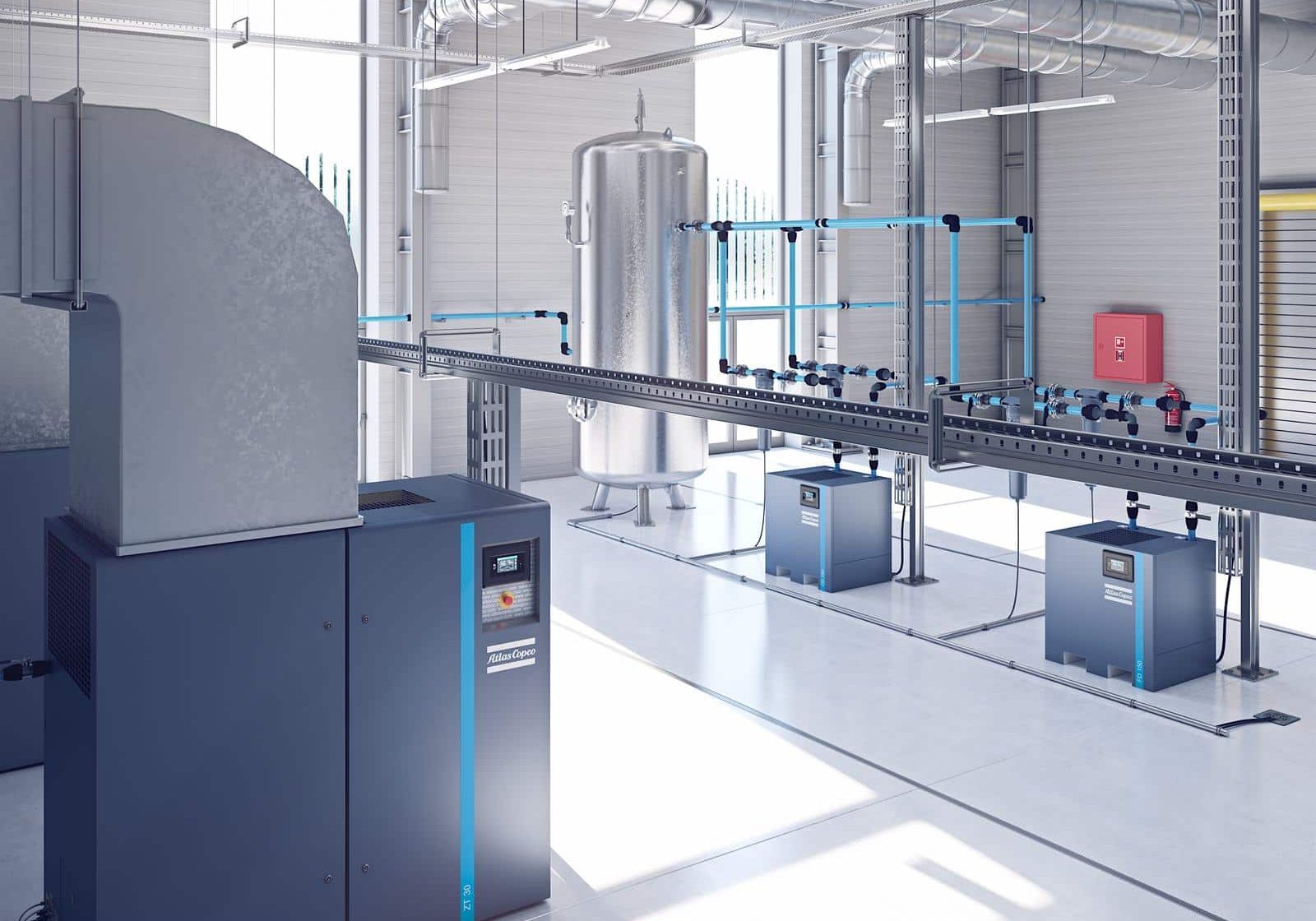
Achieving pharmaceutical-grade air quality requires an integrated system where each component works to purify the air in stages.
Compressor Technology: The Case for Certified Oil-Free
The foundational choice is the compressor. For the pharmaceutical industry, the only truly safe option is a certified Class 0 oil-free compressor. These machines, like the Atlas Copco Z-series, eliminate the risk of process contamination and lower the total cost of ownership (TCO).
Atlas Copco’s Variable Speed Drive (VSD+) technology reduces energy use by up to 35%, and energy recovery systems can return otherwise wasted heat to your facility. Explore our Oil-Free Air Compressors Guide for a detailed comparison.
The Purification Train: A Sequence for Purity
Downstream from the compressor, a correctly specified "purification train" is essential:
1. Aftercooler & Water Separator
Removes up to 70% of the water vapour.
2. Air Dryer
A desiccant dryer is mandatory to achieve the -40°C PDP needed to stop microbial growth. You can learn more about different Air Compressor Dryers here.
3. Multi-Stage Filtration
A series of high-quality air compressor filters removes remaining particulates. An activated carbon filter is vital for removing atmospheric hydrocarbons.
4. Sterile Filter
For aseptic applications, a point-of-use 0.2-micron filter is the final barrier.
Lifecycle Management: Sustaining Compliance and Efficiency
Installation is only the beginning. Without documented validation and preventative maintenance, even a well-designed system can fall out of compliance, exposing the facility to audit failures, production stoppages, and reputational damage.
- System Validation (IQ, OQ, PQ): This mandatory GMP process provides documented proof that your system is installed, operates, and performs to specification.
- Preventative Maintenance: A rigorous maintenance schedule preserves the system's validated state and is crucial for passing MHRA audits.
- Air Quality Monitoring & Audits: Regular Compressor Air Quality Testing verifies ongoing compliance. Energy audits can identify costly leaks and optimise system pressure.
Your Specialist Partner for Pharmaceutical Compressed Air
The complexity of pharmaceutical compressed air demands a partner with deep, sector-specific expertise. As an Atlas Copco Premier Distributor, Control Gear has over 50 years of experience designing and maintaining GMP-compliant systems.
We offer a turnkey service from risk assessment through to validation support. Expert service from ISO 9001, 14001 and 45001 accredited, certified engineers in Cardiff, Swansea, Newport, Bristol, Stroud and Swindon. We offer hassle-free, long-term support with no hidden charges thanks to our Guardian Service Plan.
Why Work With Us?
Frequently Asked Questions
What is Class 0 oil-free air?
Class 0 is the highest air quality classification in ISO 8573-1: 2010, and the only one that is based on testing and certification to the limits of measurement rather than set limits. This provides the greatest assurance of non-contamination of your product.
Why is a desiccant dryer necessary for pharmaceutical applications?
Desiccant dryers are the only technology that consistently meets a pressure dew point of -40°C, a level of dryness that renders microbial growth impossible, a key GMP and contamination control requirement.
How often should our pharmaceutical compressed air system be tested?
Maintenance requirements will vary, but as a minimum, a full air quality test at critical points of use should be carried out at least annually as part of your preventative maintenance program to provide the documented evidence needed to prove ongoing compliance in an MHRA audit.
Secure Your Compliance and Efficiency
Don't leave your product quality and regulatory standing to chance. Contact Control Gear today to request a GMP compliance audit, schedule a consultation with our engineers, or get a tailored quote for a new installation.