

Is Your Air Compressor Costing You More Than It Should? How Correct Sizing Saves Energy & Money
Up to 80% of a compressor’s lifetime cost is energy.
Get the size wrong, and those costs can skyrocket.
An improperly sized compressor wastes immense amounts of energy. It inflates operating costs. It can jeopardise your entire operation.
Correctly sizing your system is not a technical choice. It’s a fundamental business decision. It’s a core business decision – one that shapes financial health, operational reliability, and long-term sustainability.
Are you a facility manager or business owner in South Wales or the West? If so, this is your first step towards a more efficient operation.
Signs Your Compressor Is Sized Incorrectly
An improperly sized air compressor falls into one of two categories. Each has its own set of costly consequences.
The Undersized Compressor
An undersized compressor is forced to run continuously to meet demand. This constant operation leads to critical issues:
- Pressure Drops: The system can’t maintain the required pressure. Tools operate inefficiently, stall, or fail. Productivity drops.
- Accelerated Wear: Constant stress causes components to fail earlier than expected, driving up repair costs.
- Higher Energy Bills: An undersized system that runs nonstop wastes energy – and money.
The Oversized Compressor
An oversized compressor is equally inefficient. It satisfies air demand too quickly and then “short cycles” – it turns on and off frequently. This results in:
- Wasted Energy: A large amount of energy is consumed each time the motor is switched on. The frequent switching on and off results in a high energy bill.
- Increased Mechanical Stress: The continuous on and off switching results in excessive stress on the motor and compressor. This increases the wear and tear, reducing the life of the equipment.

The Key Metrics for Correct Sizing
Don’t look at a compressor’s horsepower alone. Accurately sizing a system requires a detailed analysis of two foundational metrics.
- Airflow (CFM/l/s): The Volume of Work
This is the most critical metric. It measures the volume of air a compressor delivers per minute. To calculate your total need, sum the CFM or l/s requirements of all tools used simultaneously. Add a 25–30% buffer to the total. This safety margin covers air leaks, which in poorly maintained systems can cause 20–30% of total air loss. - Pressure (PSI/bar): The Force Behind the Work
This measures the force at which air is delivered. The compressor must provide the highest PSI required by any single tool. However, avoid forcing an entire system to operate at an artificially high pressure. A pressure drop of only 10 PSI can push energy use up by as much as 7%. To avoid that, use a local pressure booster for single-tool needs instead of increasing pressure across the whole system.
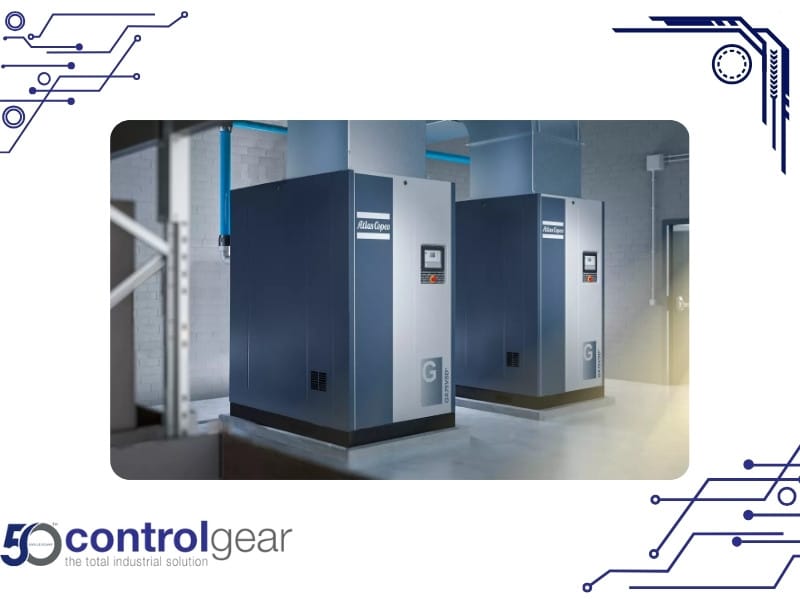
Choosing the Right Compressor Technology
Your application’s duty cycle is the most important factor when choosing between technologies. For a detailed breakdown of different compressor types, read our guide on Different Types of Air Compressor Explained.
Piston vs. Rotary Screw Compressors
Piston compressors suit intermittent, low-demand applications. They have a duty cycle of 20-30%. Rotary screw compressors are designed for continuous, high-volume industrial air supply.
They offer a 100% duty cycle, making them the ideal choice for most manufacturing environments.
Fixed Speed vs. VSD Compressors
Fixed-speed compressors are only efficient at full capacity. For businesses with fluctuating air demand, this wastes significant energy. Variable Speed Drive (VSD) technology, pioneered by our partner Atlas Copco, automatically adjusts motor speed to match real-time air demand.
It can cut energy consumption by up to 35%, and up to 60% with newer models. While some brands offer lower upfront costs, the focus on lifecycle efficiency and predictive maintenance delivers a much lower total cost of ownership.
Sizing the Entire Compressed Air System
An efficient system is a holistic one. An air compressor is just one component. Our guide on How to Make Your Air Compressor More Efficient offers more details on these and other optimisations.
- Air Receiver Tank: A properly sized tank acts as a buffer. It stabilises pressure and prevents short cycling.
- Piping and Layout: Undersized or poorly designed piping causes pressure drops. A “ring main” or “loop” layout distributes air more evenly.
- Ancillary Equipment: Components like dryers and filters must be sized correctly. This prevents pressure drops. Note that certain ancillary components, such as some dryers and master controllers, are on the UK’s Energy Technology List (ETL) and may qualify for tax incentives.
UK Compliance and Standards
In the UK, compressed air systems are subject to stringent regulations.
- Pressure Systems Safety Regulations (PSSR 2000): Any system with a stored energy exceeding 250 bar-litres must be safeguarded against potentially dangerous failure by means of a Written Scheme of Examination (WSE).
- The Provision and Use of Work Equipment Regulations (PUWER 1998): This act of parliament ensures all work equipment is safe for use and maintained to a high standard.
- The Control of Noise at Work Regulations 2005: The noise risks from work must be managed so that employees are not damaged by the sound.
- ISO 8573-1: This is the international standard for air purity. Selecting the correct purity class is an important way to protect product quality. Class 0 certified oil-free compressors are required in many food and pharmaceutical industries. Read more in our article PET Air Compressor Sizing: How to Choose the Best.
The Control Gear Advantage
Established in 1973, Control Gear has over 50 years of expertise in providing turnkey fluid power solutions.
Why Choose Control Gear?
- Over 50 years’ expertise – in compressed air and fluid power solutions.
- Atlas Copco Premier Distributor – access to world-leading equipment.
- End-to-end support – covers everything from audits to servicing.
- Specialist services – from breathing air quality testing, leak surveys and energy efficiency audits.
- Regional coverage – South Wales and the West, including Cardiff, Newport, Swansea, Bristol, Stroud, Swindon and further afield.
The best way to be sure your compressed air system is correctly sized and running at optimum efficiency is a professional compressed air audit. This will also help to identify areas of inefficiency across your system, so you can be sure you are not overpaying or facing any future downtime.
You can find out more about what this involves in our guide to the Benefits of a Compressed Air Audit.
Book your compressed air audit with Control Gear today. Gain full visibility of your system’s performance and ensure long-term efficiency, compliance and savings.