

What Are the Benefits of a HYDAC Accumulator?
A HYDAC hydraulic accumulator is an essential device for your hydraulic system.
It works like a ‘mechanical battery’ to store energy, protect your expensive components, and keep your operation safe. As a global leader, HYDAC sets the standard for this technology.
For your UK facility, a properly specified accumulator from Control Gear means lower energy bills, a longer life for your equipment, and peace of mind that you are meeting PSSR 2000 legal compliance.
This article breaks down the core benefits of a HYDAC accumulator, how the technology functions, and the legal responsibilities that apply to its use in the UK.
What is a Hydraulic Accumulator?
A hydraulic accumulator is a pressure vessel – typically forged steel – that holds stored energy within the system. You could call it a “mechanical battery.” It holds pressurised fluid (up to 690 bar) and lets it out right away when the system needs it.
This simple tool is what makes the hydraulic circuit run more smoothly, safely, and efficiently. (To learn more, read our guide to hydraulic accumulators).
Inside the steel shell, two elements are kept apart: the hydraulic fluid, which doesn’t compress, and the gas charge – always dry nitrogen – which compresses easily. A bladder, piston, or diaphragm sits between them to keep that separation intact.
Your pump pushes fluid into the accumulator when it runs.
This compresses the gas and stores energy. The compressed gas quickly expands and pushes the fluid back out when your system needs that power.
To work correctly, it relies on three key pressure settings that our engineers use for setup:
| Pressure State | Definition |
| $P_0$ (Pre-charge) | The pressure of the dry nitrogen gas before any hydraulic fluid enters. |
| $P_1$ (Min. Operating) | The lowest system pressure during your machine’s work cycle. |
| $P_2$ (Max. Operating) | The highest system pressure, when the accumulator is fully “charged” with fluid. |
What are the Main Types of HYDAC Accumulators?
HYDAC builds three core designs: bladder, piston, and diaphragm.
Which one fits best comes down to what you need in practice – speed of response, energy capacity, or how easily the unit needs to be mounted.
- Bladder Accumulators: These are the most widely used and deliver the quickest reaction time. They’re well suited to taking the edge off sharp pressure spikes and smoothing out pump pulsations. For proper operation, they need to be installed vertically – with the gas valve facing upward.
- Piston Accumulators: If you’re working with larger fluid volumes – over 100 litres or so – or running the system at high pressures, a piston unit tends to make more sense. They’re tough enough to handle demanding loads, and you can add position sensors so you can see the fluid level as it moves.
- Diaphragm Accumulators: Diaphragm accumulators are compact and low-maintenance – and they’ll operate reliably in any orientation. That freedom makes them a practical option for mobile machines or setups where every bit of space has to be used carefully.
- Metal Bellows Accumulators: These sit in a more specialist category, built for tough environments such as wide temperature swings – from around –40°C up to +80°C – or systems running aggressive chemical fluids.
How Does an Accumulator Improve System Performance?
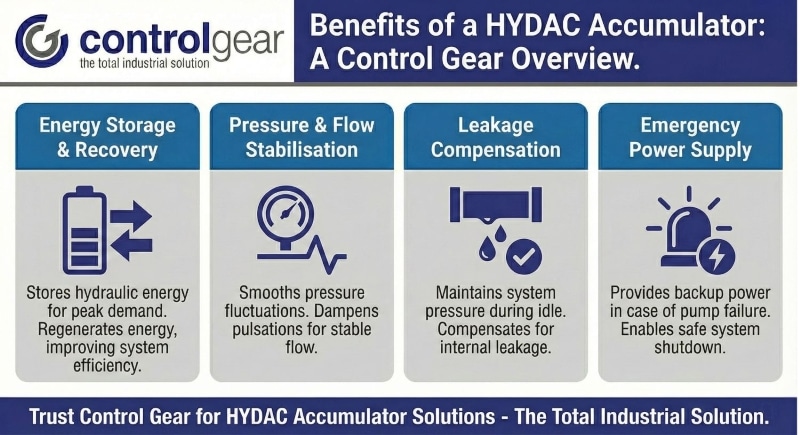
A HYDAC accumulator helps the whole system run smoother – it cuts energy use, reduces wear on critical parts, and adds a layer of safety to day-to-day operation.
How Does an Accumulator Improve Energy Efficiency?
It’s a straightforward way to bring down running costs.
With an accumulator in place, you can use a smaller, more efficient pump instead of sizing everything around occasional peak loads.
During quieter moments, the accumulator stores spare energy. When the system suddenly needs extra power, that stored energy steps in alongside the pump, covering the peak without requiring a larger unit.
This means that your main pump is the right size for the average need, not the highest need.
This saves you money on the initial purchase (CAPEX) and every day after that, it lowers your energy bills (OPEX) by a lot. It also makes your pump last longer and lowers the heat, which makes your hydraulic oil last longer.

How Does an Accumulator Protect Hydraulic Systems?
Your system’s best defence is an accumulator. It absorbs shocks, which makes your most expensive parts last longer.
1. It Stops Destructive Shocks: When a valve snaps shut, it can send a pressure surge through the line – the classic “water hammer” that blows out seals or damages hoses. The gas cushion inside the accumulator absorbs that spike in an instant, giving the rest of the circuit a layer of protection.
2. It Quiets the System: A lot of hydraulic pumps make a steady “ripple” or pulse. This vibration makes noise and slowly breaks down fittings, seals, and gauges. The accumulator makes these pulses less noticeable so that the machine runs more smoothly and quietly.
Has your system started making more noise than usual? A sudden jump in sound or vibration is often a clue that the accumulator isn’t doing its job – usually because the gas has leaked out or the bladder has torn. A Control Gear technician can check it over quickly and pinpoint the issue before it leads to bigger damage.
What Safety Functions Does an Accumulator Perform?
Even when your machine is off, an accumulator keeps you safe.
- Emergency Power: A charged accumulator still holds pressurised fluid even if your main power goes out. This can be used to do one last safe thing, like lowering a lift to the ground or turning on a safety brake.
- Leakage Compensation: It keeps your pump from “short cycling.” The accumulator provides the make-up fluid instead of the pump turning on every few minutes to fill in small leaks. This saves energy and wear.
- Thermal Expansion Protection: This is an important safety feature. When hydraulic fluid gets hot, it gets bigger. In a sealed system, this can build up enough pressure to rupture components. The accumulator safely absorbs this expansion, protecting your system and your staff.
How Do Accumulators Relate to Air Compressors?
While most compressors are electric, some specialist industrial units (including certain Atlas Copco models) use a mechanical hydraulic motor to run the air-end.
This hydraulic drive system must have an accumulator to work reliably.
The accumulator in this circuit does two jobs: it protects the hydraulic motor from pump pulsations, and it absorbs the heavy torque “kick” that comes back from the compressor. Without it, the hydraulic motor would fail quickly.
In other VSD compressor systems, accumulators are also used to stabilise pressure and support energy recovery modules.
What are the Essential Maintenance and Safety Rules?
An accumulator is a container that holds a lot of energy at a high pressure. A trained professional must do the maintenance.
The Golden Rule: Use Nitrogen Only
An accumulator must only be charged with an inert gas, almost universally dry nitrogen ($N_2$).
SAFETY WARNING: Never use “shop air” or pure oxygen. Using oxygen in a high-pressure oil system creates a severe ignition risk due to the diesel effect. This is a major safety hazard for your operators and facility.
Why Pre-Charge is Everything
The nitrogen pre-charge (known as $P_0$) is the single most important setting. If it’s wrong, the accumulator will destroy itself.
- If Pre-Charge is Too Low: The bladder gets crushed and torn.
- If Pre-Charge is Too High: The bladder slams into the valve and shatters it.
This is not a ‘set it and forget it’ part. We recommend a pre-charge check every 6 to 12 months. Our Control Gear engineers have the correct, safe charging equipment to test and service your accumulators.
Why is UK Legal Compliance So Important?
This is a legal requirement that many facilities overlook. Because an accumulator stores energy (the compressed nitrogen), it is governed by the Pressure Systems Safety Regulations (PSSR 2000).
Many incorrectly assume PSSR doesn’t apply to hydraulic systems. It absolutely does, and compliance is mandatory.
The 250 Bar-Litre Rule Explained
The most important test is the “bar-litre” value of your vessel. This is its volume in litres times its maximum pressure in bars (PS).
Example: 150 bar (Maximum Pressure) x 20 Litres (Volume) = 3,000 bar-litres
You need to have a “Written Scheme of Examination” (WSE) before you can use it if this number is more than 250.
Most industrial accumulators are well over this 250 threshold. Operating without a WSE is a criminal offence that can shut down your site and invalidate your insurance.
Control Gear acts as the “Competent Person” to handle this for you. We manage your full PSSR compliance, from the initial audit and creation of your WSE to performing the scheduled inspections.
What Other Technologies Does HYDAC Offer?
HYDAC provides a complete ecosystem to support your accumulator. (Explore the full range of HYDAC Hydraulic, Filtration & Electronic solutions we offer).
This includes smart condition monitoring sensors like the AquaSensor (for water) and ContaminationSensor (CS) (for particles). These tools help you move to predictive maintenance, tracking pressure trends and even detecting gas loss before it causes a failure.
For mobile machinery, HYDAC’s weight-reduced accumulator designs lower the overall mass of your equipment, which saves fuel and makes mounting easier.
A HYDAC accumulator is more than just a component; it is an essential asset for your facility’s efficiency, protection, and legal compliance.
To schedule a PSSR-compliant inspection, request a Written Scheme of Examination, or get expert help specifying the right HYDAC accumulator for your system, contact the Control Gear engineering team today.
We manage everything from initial site audits and WSE creation to ongoing hydraulic accumulator repair and recertification.