
Guide to Air Compressor Oil – How to Get the Best One?
Selecting the appropriate oil for your air compressor is a critical maintenance decision that directly influences the performance and longevity of your device.
Oil serves multiple purposes in an air compressor, from reducing friction between moving components to dissipating heat and sealing internal parts against air leakage. Poor oil selection can lead to increased energy consumption, excessive wear, and even equipment breakdown.
Poor oil selection can lead to increased energy consumption, equipment damage, and even total breakdown.
Understanding Oils and Lubricants for Air Compressors
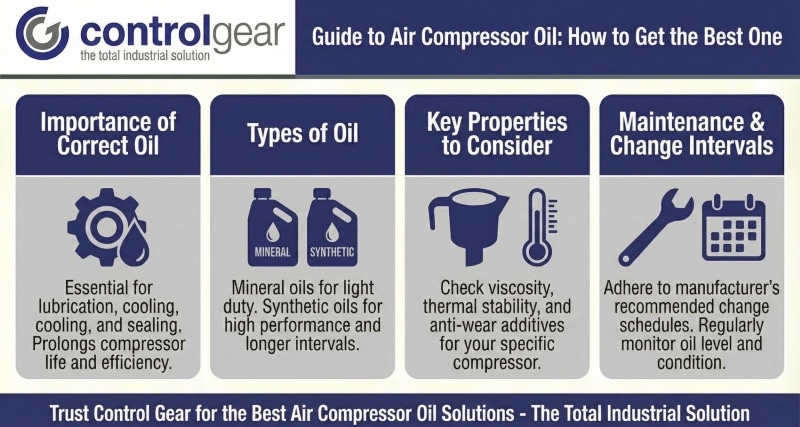
Selecting the right oil type is crucial for air compressor maintenance and long-term reliability. Air compressors need oil to lubricate moving parts, cool internal components, prevent wear, and protect the compressor from damage. Using the correct oil ensures optimal performance and extends the oil change intervals, reducing maintenance frequency.
Types of Air Compressor Oil
Understanding the different types of air compressor oil is essential if you want to keep your compressor system running smoothly. Compressor oils often vary in composition and performance, so selecting the correct oil type for your application ensures optimal performance and longer service life.
Mineral Oil
Mineral oil is considered the standard air compressor oil for light-duty applications. Commonly used in air compressors, such as older piston models, it provides basic lubrication but requires frequent changes. If you add oil regularly and operate under steady conditions, this can be a cost-effective option.
Best for:
- Older or portable compressors
- Lower usage where oil is replaced often
- Basic compressor systems
Synthetic Oil
Synthetic compressor oil is designed for more demanding environments. It withstands higher temperatures, offers excellent lubrication, and extends oil change intervals. This type of oil is recommended for rotary screw compressors and systems running for long hours. Using this oil for optimal performance can also reduce energy consumption and component wear.
Best for:
- High-demand, continuous-use compressors
- Industrial settings requiring heat resistance
- When you need to know about air compressor longevity
Semi-Synthetic Oil
This is a blend of mineral and synthetic oils, providing a balance between performance and cost. It’s commonly used in air compressors across workshops and commercial settings where full synthetic might be excessive. Semi-synthetics still deliver enhanced protection and longer life compared to standard oils.
Best for:
- Medium-duty compressor systems
- Users upgrading from mineral oil
- Environments with variable temperature loads
Food-Grade Oil
Food-grade oil is used in air compressors for sensitive applications where air contamination must be avoided. It meets strict FDA and ISO standards and is both tasteless and odourless. This oil is essential in industries where air compressors rely on purity, such as food, beverage, and pharmaceutical production.
Best for:
- Food & beverage processing
- Medical and pharmaceutical applications
- Any system requiring ISO Class 0 air
Why Oil Type Matters
Different air compressor models require specific grades of oil. Using the wrong oil – such as motor oil in your air compressor – can cause excessive carbon buildup, overheating, and damage to your air compressor.
For rotary screw air compressors, a high-performance synthetic oil like Roto-Xtend Duty Fluid is ideal, while reciprocating air compressors benefit from regular oil changes with the right oil for your compressor. Oil filters also play a key role in keeping your compressor operating efficiently by removing contaminants.
Oil should be changed according to the manufacturer’s recommended oil change intervals to maintain optimal performance. Always consult your compressor manual to select the right oil and ensure your air compressor operates efficiently.
Choosing the Right Oil
Selecting the correct oil type for your air compressor depends on the compressor model, operating conditions, and manufacturer guidelines. Compressors require oil that is specifically formulated to lubricate, cool, and seal internal components without causing build-up or damage.
Rotary screw compressors typically perform best with synthetic oil due to continuous high-demand operation. Piston compressors may be suitable for mineral oil, provided you replace the oil regularly and maintain the correct oil level.
Avoid using products like motor oil or hydraulic oil. These contain additives that are not designed for compressor systems and may cause foaming, overheating, or seal deterioration. Using the wrong oil can lead to increased wear and reduced efficiency.
Always use air compressor oil with the correct ISO viscosity grade and refer to your manufacturer’s manual. If you have any questions about air compressor oil, seek expert advice. Choosing the right oil protects your investment and ensures long-term performance.
Atlas Copco’s Air Compressor Oils
Atlas Copco offers a wide range of speciality oils designed to meet the needs of different oil-lubricated air compressors.
For example, the Atlas Copco Roto-Inject Fluid is a long-life, high-performance synthetic air compressor oil created for the Atlas Copco GA, GX and GR range of rotary screw compressors.
Another notable product is the Atlas Copco Roto-Xtend Duty Fluid, a super high-performance synthetic oil designed for high-pressure screw compressors operating under severe conditions.
For food and beverage industry applications where accidental oil contact with food or food packaging can occur, Atlas Copco offers Atlas Copco FDA-approved Food-Grade Oil. This synthetic compressor oil is tasteless, odourless, and formulated with ingredients that comply with FDA regulations.
In applications that use older or high-usage air compressors, Atlas Copco Roto-Z oil is an ideal choice. This mineral oil-based lubricant offers good resistance to oxidation and protects against rust and corrosion in any air compressor pump, effectively extending the lifespan of your compressor parts.
Choosing Atlas Copco oil means getting a product that has been rigorously tested and proven to perform under the designated operating conditions.
As always, consult your manufacturer’s guidelines and seek expert advice when selecting the most suitable oil for your air compressor.
These oils are rigorously tested to ensure compatibility and optimal performance in their designated applications.
Oil Maintenance and Change Frequency
Just as important as choosing the right oil is maintaining it appropriately. How often will you need to change the oil? That will largely depend on the type of oil and compressor usage patterns.
Regular oil analysis is a proactive maintenance approach that can help identify potential issues before they turn into costly repairs. Following the manufacturer’s maintenance intervals will aid in extending the compressor’s lifespan and maintaining its peak performance.
Atlas Copco recommends adhering to specified maintenance schedules to maximise compressor efficiency and longevity.
Recommendations Based on Applications
Given the range of Atlas Copco oils, here are some recommendations tailored to specific air compressor applications:
Heavy Industrial Applications
Atlas Copco Roto-Xtend Duty Fluid is an excellent choice for heavy-duty applications involving high-pressure compressors operating under severe conditions.
It is a super high-performance synthetic lubricant that offers superior heat absorption and oxidation resistance, ensuring optimal performance and extended compressor lifespan.
Its ISO Viscosity Grade is 46, with a flash point of 260°C, indicating its excellent resistance to extreme temperatures.
Food and Beverage Industry
Atlas Copco’s FDA-approved Food-Grade Oil is the ideal choice for applications in the food and beverage industry where accidental oil contact with food or food packaging must be avoided. This oil complies fully with FDA regulations and is odourless and tasteless. It has an ISO Viscosity Grade of 46 and a flash point of 270°C, providing optimal lubrication and protection against corrosion even under high operating temperatures.
High-Usage or Older Compressors
Atlas Copco Roto-Z is recommended in the case of older or frequently used air compressors. This mineral oil-based lubricant offers oxidation resistance and protects against rust and corrosion. Its ISO Viscosity Grade is 32, and it has a flash point of 210°C, offering excellent stability and protective qualities to extend the lifespan of compressor parts.
General Applications
Consider Atlas Copco Roto-Inject Fluid for general applications. Specifically created for Atlas Copco’s GA, GX, and GR range of rotary screw compressors, this long-life high-performance synthetic oil has an ISO Viscosity Grade of 46 and a flash point of 230°C. It offers high resistance to heat, and superb lubrication under most operating conditions.
Remember, these are general guidelines and specific needs can vary. Always consult the manufacturer’s guide or reach out to an expert for personalised advice tailored to your situation.

Risks of Using the Wrong Oil
Using the wrong oil poses risks such as equipment damage, increased energy consumption, and, in extreme cases, total breakdown.
Environmental factors like temperature and humidity can also affect oil performance, accelerate oil ageing, and increase compressor wear and tear.
Always consult the manufacturer’s guidelines and use Atlas Copco-approved oils for guaranteed compatibility and safety.
Technical Differences Between Motor Oil and Air Compressor Oil
You cannot use standard motor oil in air compressors. The essential difference between motor oil and air compressor oil lies in their respective viscosities and operating environments. Viscosity, measured in units of centistokes (cSt) or square millimetres per second (mm2/s), is a crucial parameter that influences how effectively an oil lubricates, cools, and seals.
Motor oil typically has a viscosity range from 5W-40 to 20W-50, where ‘W’ stands for winter. This multidimensional viscosity ensures that the oil remains fluid in cold temperatures (for cold starts) and retains its thickness at high temperatures to protect the engine.
Air compressor oil is generally single-grade with a viscosity range of 32 to 46 cSt at 40°C because air compressors operate in a much narrower temperature range compared to vehicles, and they require oil that can retain an optimal thickness across this range.
Using motor oil in air compressors can compromise lubrication, increase wear, and void warranties.
Oil-Free Compressors
Oil-free compressors offer a clean, efficient, and low-maintenance solution for industries where air purity is non-negotiable. Unlike traditional oil-lubricated compressors, these systems do not require oil within the compression chamber, eliminating the risk of oil contamination in the compressed air. This makes them ideal for pharmaceuticals, food and beverage production, electronics manufacturing, and medical applications.
How Do Oil-Free Compressors Work?
Oil-free compressors operate using specialised coatings, water injection, or advanced materials that reduce friction and heat dissipation without needing oil. Some models, like rotary screw and scroll oil-free compressors, use precision-engineered components to maintain efficiency and durability over time.
While oil-lubricated air compressors require regular oil changes and maintenance, oil-free systems are designed to be low maintenance with fewer consumables. This reduces operational costs and eliminates the need for oil filters and condensate management systems, making them an environmentally friendly choice.
Advantages of Oil-Free Air Compressors
- 100% Oil-Free Air – eliminates the risk of product contamination, making them essential for sensitive industries.
- Lower Maintenance Costs – no need for oil changes, filters, or disposal of oil-laden condensate.
- Energy Efficiency – many oil-free models operate more efficiently, reducing energy consumption over time.
- Environmentally Friendly – no oil waste or pollution, ensuring compliance with strict environmental regulations.
- Consistent Air Quality – meets the strictest ISO 8573-1 CLASS 0 (2010) certification for air purity.
Oil-Free Compressor Solutions from Atlas Copco
Atlas Copco offers a range of high-performance, oil-free compressors designed for various applications:
- ZT/ZR Series – rotary screw compressors delivering 100% pure, ISO-certified oil-free air, perfect for food processing and pharmaceutical industries.
- SF/SFX Series – scroll compressors with low noise levels and high energy efficiency, ideal for laboratories and electronics manufacturing.
- ZD Series – high-pressure reciprocating compressors used in bottling plants and nitrogen generation.
- ZS Series – oil-free screw blowers tailored for wastewater treatment, pneumatic conveying, and industrial processes.
Is an Oil-Free Compressor Right for You?
Investing in an oil-free compressor ensures compliance, efficiency, and long-term savings if your industry demands clean, contaminant-free air. While oil-lubricated compressors offer higher durability for heavy-duty applications, oil-free systems provide unmatched air purity and lower maintenance needs.
Consult our team at Control Gear today for expert guidance on selecting the best oil-free compressor for your application.
Atlas Copco Oil-Free Compressors: Product Highlights
Atlas Copco’s oil-free compressors are a testament to the company’s commitment to technology, innovation, and sustainability.
Here are a few product highlights that offer clean, high-quality compressed air:
ZT/ZR Series
The ZT/ZR oil-free rotary screw compressors provide 100% pure, clean air that complies with ISO 8573-1 CLASS 0 (2010) certification. With an output capacity of 5.5 – 55 kW, these compressors are suitable for sensitive applications such as food & beverage production, pharmaceuticals, and electronics manufacturing.
SF/SFX Series
These oil-free scroll compressors offer silent operation and high energy efficiency. The SF/SFX series, with an output capacity range of 1.5 – 22 kW, is perfect for demanding applications that value low noise levels and minimal maintenance.
ZD Series
The ZD high-pressure, oil-free reciprocating compressors offer a flexible, reliable, and high-quality source of compressed air up to 70 bar. With an output capacity of 6.7 – 37.5 kW, they are ideal for applications like PET bottle blowing and nitrogen generation.
ZS Series
The ZS series of oil-free positive displacement screw blowers is a perfect choice for applications requiring high-capacity air. With an output capacity of up to 22.5 – 160 kW, the ZS series is popular in wastewater treatment plants, pneumatic conveying, and power generation facilities.
These oil-free compressors by Atlas Copco are designed with the user’s needs and environmental sustainability in mind. They assure users of high-quality, contaminant-free air, and significantly reduced energy costs.
Final Thoughts on Air Compressor Oil Types
Choosing the right air compressor oil can significantly enhance your compressor’s performance and extend its lifespan. Always refer to the manufacturer’s guidelines before you change air compressor oil. Remember, an ounce of prevention is worth a pound of cure.
Investing in the right oil for your air compressor is not just a choice – it is a necessity. The performance and longevity of your equipment rely heavily on the lubrication you choose. The wrong selection could lead to costly repairs or, worse, the premature failure of your air compressor.
Oil-free compressors by Atlas Copco offer a dependable solution for industries where air purity is paramount, such as food and beverage, pharmaceuticals, or electronics manufacturing.
Proper lubrication is not just about maintenance; it is about ensuring operational excellence and protecting your investment.
These compressors ensure the delivery of clean, high-quality compressed air with a range of products designed for various output capacities and applications.
Remember, using the correct lubricant is not just about maintaining equipment. It is about ensuring efficiency, safeguarding operations from costly downtime, and contributing to a sustainable future. In the world of air compressors, the correct oil is the lifeblood of equipment.
Contact our experts
Finding the perfect oil can be quite a challenge which is why our team of experts at Control Gear is here to offer personalised advice and guide you in selecting the ideal oil for your unique needs.
Get in touch with us today and experience the difference!
FAQ
What type and grade of oil should I use for my air compressor?
Using the right oil type for your air compressor is essential for optimal performance and longevity. Different compressors require specific oils – mineral oil for light-duty applications and synthetic oil for high-performance needs. Always refer to the manufacturer’s guide to ensure you use the correct type and grade of oil for your compressor.
How often should air compressor oil be changed?
The frequency of oil changes depends on the compressor type, operating conditions, and oil type for your air compressor. Mineral oils require more frequent changes, while synthetic oils offer longer service intervals. Regular oil changes help prevent wear and contamination inside the compressor, ensuring smooth operation.
Can I use motor oil in my air compressor?
No. Motor oil used in vehicles is not suitable for air compressors. Air compressor oil contains additives that reduce carbon buildup, enhance lubrication, and prevent foaming. Using motor oil inside the compressor can lead to excessive wear, overheating, and reduced efficiency. Always use the air compressor oil recommended by your manufacturer.
What happens if I use the wrong oil in my air compressor?
Using the wrong oil, such as motor oil or hydraulic oil, can lead to overheating, carbon build-up, or damage to seals within the compressor system. Compressors require oil that is designed explicitly for lubrication, cooling, and sealing. Always use the air compressor oil recommended by the manufacturer to avoid costly repairs.
How do I know when to replace the oil in my air compressor?
Oil should be replaced according to the maintenance schedule in your user manual. However, factors such as operating temperature, usage frequency, and oil type also affect how often you need to replace the oil. Keeping an eye on the oil level and condition helps maintain performance and prevent breakdowns.
Can I top up my air compressor with standard motor oil?
It is not recommended to use motor oil in place of proper compressor oil. Motor oil contains additives that may foam or degrade seals, which can affect how the compressor functions. For optimal performance and longevity, always use the correct oil type formulated for use in air compressors.