
The Hidden Costs of Poor Dust Extraction in Workshops – and How to Avoid Them
Manufacturers have started to refer to compressed air as the “fourth utility” in workshops and factories around the world as it is responsible for virtually every mechanical system from tools to automated machinery.
There’s just one hitch:
Your fourth utility’s quality and performance are dependent on your facility’s air quality.
Dust is more than a nuisance and an eyesore. It’s a silent killer of your business, a pervasive liability that inflates your costs and weakens your operations on a systemic level.
But how much does it cost?
Control Gear’s latest white paper lifts the lid on the real cost of uncontrolled dust, and how a small investment in the right resources and equipment, backed up by Control Gear’s expertise, can help to safeguard your bottom line.
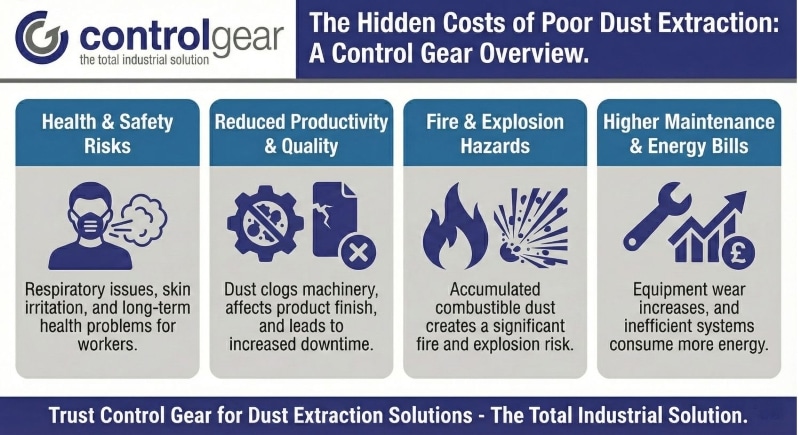
The Hidden Costs of Poor Dust Extraction
The costs of poor dust control are more than the time taken to sweep a floor. They are an ongoing and avoidable erosion of your bottom line.
Energy Waste
Inefficient dust control means higher utility bills. Airborne dust particles overload and clog the intake filters and cooling paths of your air compressor. This forces the unit to work harder to maintain system pressure.
For every 1.0 bar of additional pressure, your compressor’s power consumption increases by 7–8%. This leads to a higher energy bill for you.
Dust collectors also use energy, and pulse-jet cleaned dust collectors can waste it if pulse timing is poorly tuned, diaphragm valves leak, or the air receiver is too small. All of these problems can cost you thousands of cubic metres of compressed air a year, which is a direct waste of energy.
Equipment Wear & Downtime
Dust is abrasive. It wears away at your expensive equipment.
Fine dust in your compressed air system prematurely wears out valves, cylinders, and pneumatic tools. The result is a much shorter service life. On top of this, it also fouls coolers and heat exchangers. And in some cases, it can even make them overheat and fail unexpectedly.
For you, this means more repair calls, increased maintenance costs and missed production deadlines.
Compliance Risks
Dust management is not optional in the UK. It’s the law.
Non-compliance can lead to unlimited fines and even legal action. Under the COSHH Regulations, employers must protect workers from harmful substances. This includes wood dust and respirable crystalline silica.
All Local Exhaust Ventilation (LEV) systems must be thoroughly examined and tested (TExT). This should occur at least every 14 months in accordance with the HSE’s HSG258.
In addition to COSHH, the DSEAR applies to combustible dusts. Your compressed air receivers are covered by the PSSR 2000. You must comply with these regulations to avoid financial and legal penalties.
Worker Health & Retention
Bad dust extraction impacts your people. Fine dust particles can cause debilitating conditions. This includes occupational asthma and silicosis.
Beyond health impacts, a dusty environment has other negative effects. It’s distracting, reduces focus, and can even hit your productivity. It also creates a sense of corporate indifference, leading to disengagement and employee churn.
In the UK, the average cost of replacing one employee is £25,000. Proper dust control can help.
Product Quality & Reputation
Dust can make its way onto finished goods in a workshop environment. This creates defects, reworks, customer complaints, lost profitability, and a damaged reputation.
One joinery company reduced costs by £8,000 per year by using wood waste as a heating fuel, cutting out waste disposal costs.
Technical Solutions for Your Workshop
As a premier distributor for Atlas Copco and an authorised Nederman partner, Control Gear provides end-to-end solutions for workshop air quality. For a comprehensive overview, visit our Dust & Fume Extraction Solutions page.
- VSD/VSD+ Compressors: Our VSD compressors match air output to demand. This significantly reduces your energy consumption.
- Filtration & Dryers: We install multi-stage filtration trains and dryers. This helps you meet specific ISO 8573 air quality classes. This prevents contamination and protects your equipment.
- Pulse-Jet System Optimisation: Our engineers diagnose and fix inefficiencies in your dust collector. We fix leaking diaphragm valves and poor pulse timing. This ensures it works effectively without wasting compressed air.
Why Partner with Control Gear?
Control Gear combines top-tier technology with in-house excellence. With over 50 years of expertise across South Wales and the West, we provide the complete solution.
We don’t just supply equipment. We conduct comprehensive air leak surveys and energy audits. We also perform mandatory LEV (Local Exhaust Ventilation) Testing.
To learn more, explore our full range of Compressed Air Service and Maintenance options.
Common Questions on Dust Extraction in UK Workshops
How often should LEV be tested in the UK?
All LEV systems must be thoroughly examined and tested (TExT) at least every 14 months. This is required by COSHH regulations. For an in-depth look at the advantages, read our guide on The Comprehensive Benefits of Dust and Fume Extraction Systems.
What is the energy impact of a clogged filter?
A clogged filter increases pressure drop in the system. For every 1.0 bar of pressure drop, a compressor’s energy consumption can increase by up to 8%. A regular air filter change-out is one of the simplest ways to maintain efficiency and reduce costs.
What ISO 8573 class do I need for my process?
The required ISO 8573 class depends on your application. For general workshop tools, a basic particulate filter may be enough. But for sensitive processes like spray painting or food packaging, you may need a higher class.
This helps control moisture, oil, and fine particles.
To understand the basics of fume extraction, you can also read our blog on What Is a Fume Extraction System and How Does a Fume Extractor Work?.
Book your on-site survey today. Our engineers will measure your pressure drops and give you a clear, no-obligation savings report.