
How To Avoid Microorganisms In Compressed Air
Compressed air is crucial in various industries, including the food and beverage, pharmaceuticals, and medical sectors. It’s often considered the ‘fourth utility,’ alongside water, electricity, and gas, owing to its widespread use and importance.
At Control Gear, we understand that compressed air quality isn’t just about removing physical particles like dust or oil from the air. In industries where hygiene is paramount, such as those mentioned, the potential for microbial contamination is a pressing concern.
Microorganism growth such as bacteria, viruses, and fungi, can easily find their way into compressed air coils. If not properly managed, they can cause problems, from product spoilage and decreased shelf-life in food and beverage companies, to the risk of infection in the pharmaceutical and medical sectors.
This blog will dive deep into the issue at hand, offering practical advice and showcasing the role of top-tier solutions, such as Atlas Copco products, in compressing atmospheric air safely and hygienically.
Understanding Microorganisms in Compressed Air
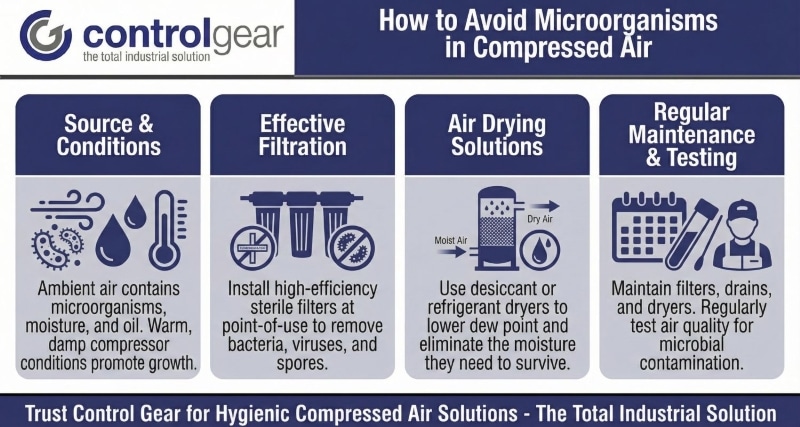
Compressed air systems can be susceptible to microorganisms like bacteria and fungi, posing serious risks in food, pharmaceuticals, and healthcare industries. These microorganisms often enter through ambient air and thrive in moisture-rich environments without sufficient drying and filtration. When air forms dew due to high relative humidity, it creates ideal conditions for microbial growth.
Biofilms, structured communities of microorganisms, can form on surfaces within the system. These biofilms are particularly challenging as they block filters, corrode equipment, and release contaminants, jeopardising system integrity and product quality.
Relative humidity levels must be tightly controlled to avoid growing organisms. Atlas Copco’s oil-free compressors, such as the ZR/ZT series, help to prevent microbial contamination by delivering dry, contaminant-free air. By achieving low dew point requirements with desiccant dryers, moisture is reduced to a level where microorganisms like bacteria cannot thrive.
Innovative pressure dew point (PDP) control ensures adherence to industry standards, minimising humidity to levels unsuitable for microbial survival. This advanced feature is key for maintaining compliance and ensuring system hygiene.
Utilising specific pressure dew point (PDP) measures instead of just relying on PDP ensures that compressed air complies with industry standards, maintaining safe humidity levels and decreasing the presence of organisms.
With the right combination of drying technologies and filtration, industries can eliminate potential sources of contamination and ensure clean, safe air in their processes.
Conditions Favouring Microbial Growth
Microorganisms thrive under certain conditions, which, unfortunately, are often present in a compressed air system.
- Moisture: When relative humidity levels exceed 75%, it creates a conducive environment for the growth and multiplication of microorganisms because water is an essential component of most biological processes. When a compressed air system has an inefficient drying process or inadequate maintenance, moisture can accumulate, encouraging microbial growth.
- Suitable Temperatures: The temperature range within a compressed air system can significantly influence microbial activity. Most microorganisms, especially bacteria and fungi, prefer a moderate ambient temperature, typically between 20°C and 40°C. However, some extremophiles can survive, and even thrive, in temperatures outside this range. So, maintaining an appropriate temperature range in a compressed air system is vital to inhibit microbial growth.
Controlling these variables with advanced solutions, such as Atlas Copco’s energy-efficient dryers, ensures operational safety and hygienic air quality.
To effectively mitigate these conditions favouring microbial proliferation, it’s imperative to control the humidity, temperature, and differential pressure within a compressed air system.
How Compressed Air Can Harbour Microorganisms
The Air Compression Process
Compressed air systems used in manufacturing or industrial environments often inadvertently concentrate contaminants found in the ambient air. These contaminants may include dust and soot particles, aerosolised oil droplets, moisture, and even microbes such as bacteria, fungi, or viruses.
During the compression process, the ambient air drawn into the system can carry these contaminants. Dust and soot may originate from indoor and outdoor sources, such as machinery, human activity, or the burning of fossil fuels. Oil contamination may stem from lubricants used within the air compressor, while moisture is a common byproduct of the compression process.
Microbes, including bacteria and fungi, thrive in this environment, especially when moisture is present. Once inside the system, they can multiply and be discharged along with the compressed air.
The Influence of Moisture and Temperature
Atlas Copco’s desiccant dryers significantly reduce water vapour concentration, lowering dew points to -70°C. This extreme dryness eliminates conditions conducive to microbial survival.
Compressed air inherently raises the temperature of the environment it interacts with. Unfortunately, the contact time during the compression process is too short to act as a sterilisation method. While heat is an effective way to kill microorganisms, it needs to be sustained over a long period to be effective. In a compressed air system, the rapid compression and subsequent cooling don’t allow for prolonged exposure to the high temperatures required to sterilise microorganisms.
Microorganisms need water to survive and proliferate. A high water vapour concentration in the air provides the perfect environment for microbial growth. By reducing the water vapour levels in compressed air, we can effectively eliminate a key factor necessary for their survival.
Atlas Copco’s desiccant dryers, for instance, can lower the dew point to an impressive -70°C, effectively removing the moisture content and helping prevent microbial contamination.
Measures to Prevent Microbial Growth
High Temperatures in Oil-free Compressors
Atlas Copco’s oil-free compressors operate at high temperatures, often exceeding 180°C, or 356°F. These temperatures are effective in sterilising air, significantly reducing microbial survival rates. This feature is indispensable for industries demanding sterile air, such as pharmaceuticals and food production. At these elevated temperatures, the survival and proliferation of microbes becomes exceedingly difficult. The heat effectively sterilises the air, reducing the likelihood of microbial contamination. Practical applications are in industries such as food and beverage, pharmaceutical, and electronics, where maintaining a sterile environment is crucial for quality control.
Maintaining Appropriate Moisture Levels
Maintaining appropriate moisture levels in a compressed air system is crucial in the battle against microbial contamination. Targeting a relative humidity level between 10% and 20% creates an inhospitable environment for most bacterial growth. This drier environment denies the damp conditions, which many harmful microbes need for proliferation. Targeting a relative humidity level between 10% and 20% creates an inhospitable environment for most bacterial growth. This drier environment denies the damp conditions, which many harmful microbes need for proliferation.
A high-quality air dryer, like the Atlas Copco CD+ and BD+ series, can efficiently reduce liquid and vapour water levels. They both boast a pressure dew point as low as -70°C, substantially reducing the likelihood of microbial growth.
Filtration
Understanding the performance, reliability, and validation of filter elements
Choosing the right filter starts with understanding its specifications. It is crucial to ensure filters have undergone rigorous testing and validation for their performance and reliability. A reliable filter effectively reduces microorganisms and ensures the quality and safety of the compressed air.
Examining technical data sheets before selecting a filter
Data sheets provide valuable information, including efficiency, flow capacity, and pressure drop. Considering this data can help you choose the most efficient and cost-effective filter.
Choosing filters based on anticipated contamination threats
Different environments pose different contamination risks. An industrial setting might present oil-based aerosols, while a humid environment may pose water threats. It is best to select filters that match the specific contaminant threats of your environment.
General coalescing air filters may be ineffective against microbial contaminants
Standard coalescing filters effectively remove oil and water contaminants but may not be sufficient for microbial pollutants. However, specialised filters like Atlas Copco’s UD+ filters combine the actions of traditional coalescing filters and dry particulate filters, offering enhanced protection against microbes.
The Importance of Testing and Validation
Regular testing and validation are critical to maintaining compressed air specifications, especially in the food and beverage, pharmaceutical, and electronics industries. Testing helps detect contaminants, such as oil, moisture, and microorganisms like bacteria, ensuring compliance with air specifications instead of PDP alone. This approach ensures proper humidity in compressed air specifications, which reduces present microorganisms and limits their growth.
Monitoring relative humidity is key, as levels between 50 and 75% can encourage microbial growth. By controlling moisture and avoiding conditions where air will form dew, businesses can prevent contamination in compressed air systems, especially when air comes into contact with the product.
Atlas Copco’s SMARTLINK technology aids real-time monitoring, ensuring that air remains free from harmful moisture and contaminants. Companies can regularly test and adjust based on compressed air specifications, ensuring product quality, maintaining food and hygiene safety, and avoiding costly operational disruptions.
Standards and Benchmarks
Understanding the standards and benchmarks for compressed air systems is key to maintaining safety and efficiency.
ISO 8573-1:2010
The first, ISO 8573-1:2010, is an international standard that outlines specifications for the quality of compressed air used in process systems. It specifies limits for contaminants like water, oil, and particulates that can interfere with processes and harm equipment.
BS EN 12021:2014
On the other hand, BS EN 12021:2014 is a British standard relevant to breathing compressed air systems. It dictates the quality of compressed air used in respiratory protective equipment, ensuring the air is free from harmful levels of contaminants that could pose a risk to human health.
Methods To Quantify Microbial Contamination
Compressed air systems often harbour various contaminants, including microbes, that may pose significant operational risks. So, it is imperative to measure and subsequently control these contaminants.
The first step in this process involves measuring parameters such as oxygen, carbon dioxide, oil mist, and water vapour. These parameters can provide insights into the general quality of the compressed air. For instance, high carbon dioxide levels could indicate the onset of microbial activity, as many microbes produce CO2 as a metabolic byproduct. Similarly, excessive oil mist can serve as a nutrient source for microbes and foster their growth.
Another method of quantifying microbial contamination is by determining the number of colony-forming units (CFUs) per 1000 litres of compressed air. This technique, also known as microbiological air sampling, is quite effective at detecting the presence and quantity of viable microorganisms.
A practical solution to control CFU levels is using specialised compressed air equipment like Atlas Copco’s oil-free air compressors, which significantly minimise the risk of contamination.
Remember, understanding and quantifying microbial contamination are crucial steps in maintaining a safe and efficient compressed air system.

Practical Steps To Ensuring Clean Compressed Air
- Fixing compressed air leaks: Leaks can create a pathway for contaminants, including moisture, oil, and particulates, to enter the system and circulate throughout. Identify and promptly seal leaks to prevent the introduction of these contaminants. Atlas Copco’s ultrasonic leak detectors provide an efficient, user-friendly method for locating and rectifying leaks, ensuring cleaner, drier, and more efficient compressed air operation.
- Installing and maintaining air dryers: Air dryers play a crucial role in maintaining compressed air quality. Refrigerated air dryers are perfect for general applications, cooling the air to condense and remove moisture before it can enter the system. Desiccant air dryers provide an additional level of protection, delivering super-dry air that inhibits microbial growth. Atlas Copco offers a comprehensive range of reliable, high-performance air dryers with superior energy efficiency.
- Regular filter changes: Filters are the frontline defence against microbial growth in compressed air systems. Always use filters with the correct pore size to effectively trap particulates and ensure clean air. Regular filter changes are also critical to preventing the accumulation of microbial growth. Atlas Copco’s comprehensive range of certified filters guarantees optimal air purity and ensures your equipment’s longevity.
- Testing and monitoring: Regular testing and monitoring of compressed air systems can provide both peace of mind, and the early detection of emerging issues. Consistent inspections can identify potential problems before they progress to causing costly downtime, or even equipment failure. Atlas Copco’s SMARTLINK offers the real-time monitoring and analysis of any compressed air system, providing actionable insights and enabling proactive maintenance for peak system performance.
Final Thoughts on Avoiding Microorganisms in Compressed Air
Maintaining pure compressed air is critical in multiple industries, from food production to medical services, and the presence of microorganisms can lead to substantial issues in product quality, health, and overall operational efficiency.
Regular monitoring and rigorous maintenance are more than just recommended procedures, they are the preventive measures that safeguard systems against microbial contamination.
With Control Gear and Atlas Copco products, it’s easy to avoid microorganisms in compressed air and invest in the longevity and efficacy of your business operations.
Take action now to protect your compressed air systems from microbial contamination. Control Gear offers advanced solutions tailored to your needs, ensuring optimal system performance and longevity.
Contact us today to learn more about our services, and how we can help safeguard your business. Invest in clean, microorganism-free compressed air for a secure future.
Frequently Asked Questions about How To Avoid Microorganisms In Compressed Air
How does Atlas Copco UK ensure the reduction of microorganism growth in compressed air systems?
Atlas Copco UK’s advanced air compression technologies are designed to reduce the risk of microorganism growth in the final product by maintaining proper air specifications instead of relying solely on pressure dew point (PDP).
By controlling the specific relative humidity and heat tolerance within the system, Atlas Copco’s oil-free compressors and desiccant dryers effectively remove contaminants from the compressed air, creating an environment that avoids the conditions microorganisms require to grow.
Why is managing the humidity in compressed air important for preventing microorganism growth?
Humidity in compressed air is critical because microorganisms require moisture to thrive. If the air within the system reaches a point where it will form dew, it can create conditions conducive to microbial growth.
By adhering to a strict compressed air specification, rather than just focusing on PDP, companies can control specific relative humidity levels, thereby avoiding the growth of harmful organisms and ensuring product safety.
What measures can be taken to remove contaminants from the compressed air and prevent microbial contamination?
To remove contaminants from the compressed air, it is essential to use high-efficiency filtration and drying systems. These systems, such as those offered by Atlas Copco UK, target and eliminate moisture, oil, and particulates, which are necessary for microorganism growth.
Maintaining proper pH levels and specific relative humidity within the air compression process also helps in reducing the presence of microorganisms, ensuring a cleaner, safer compressed air supply.