
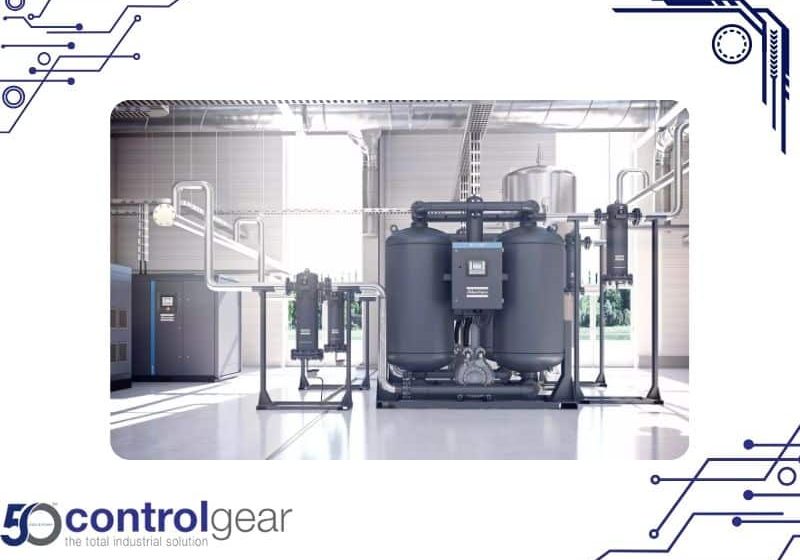
A UK Guide to Desiccant Air Dryers and Ultra-Dry Compressed Air
Standard compressed air still contains damaging moisture that can cause corrosion, contamination, and equipment failure in many industrial processes, which is why air dryers are an essential part of any compressed air system.
Although refrigerated dryers are suitable for general industrial purposes, critical applications such as pharmaceutical manufacturing, food processing, and electronics production require ultra-dry air, which is where desiccant air dryers come in. Desiccant air dryers are specialised systems that adsorb water vapour and achieve ultra-low pressure dew points (PDP).
How Desiccant Dryers Work
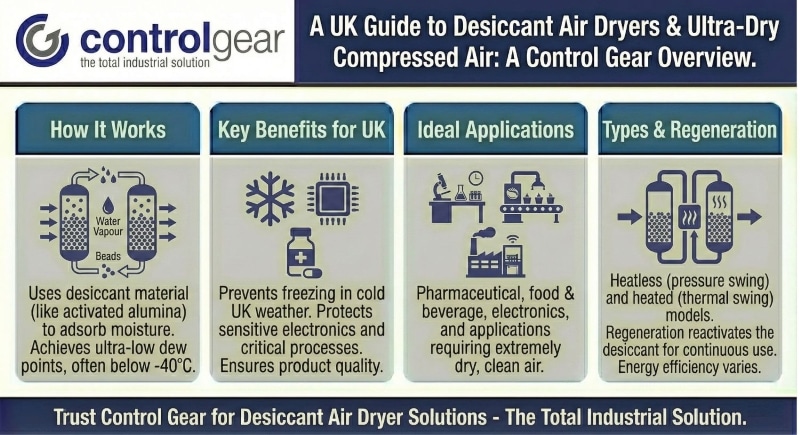
A desiccant, or adsorption, air dryer operates on a regenerative principle, using a hygroscopic material (a desiccant). This material, often silica gel or activated alumina, has an affinity for water molecules, attracting but not absorbing water.
The Difference Between Adsorption and Absorption
Desiccant dryers should not be confused with absorbers, as the drying process is distinct. Absorption is the drawing in of liquids, such as how a sponge draws in water until saturated, while adsorption is the adhesion of water molecules to the outside surface of a porous desiccant. Surface-based adsorption is an efficient and reversible process that lends itself well to a continuous drying cycle.
The Twin-Tower Regeneration Cycle
The majority of industrial desiccant air dryers are twin-tower units and will provide a continuous flow of dry compressed air using a constant cycle, which is as follows:
- Drying Phase: Wet compressed air is directed into the first tower and passes through the desiccant bed. The desiccant adsorbs the water vapour, and dry air is discharged into your facility.
- Regeneration Phase: During this time, the second tower (the water-loaded tower) is being regenerated to force the captured water out of the system.
- Switchover: As soon as the second tower has been completely regenerated and the desiccant in Tower One has become saturated, the controller will switch the air flow, reversing the roles and ensuring an uninterrupted supply of dry air.
The regeneration method used by the towers defines the dryer’s type, such as a heatless desiccant dryer or a more efficient blower purge dryer.
Understanding Pressure Dew Point (PDP) and Air Quality Standards
The Pressure Dew Point (PDP) is the temperature at which water vapour in compressed air becomes liquid water at your system’s current pressure; the lower the dew point temperature, the drier the air. The UK’s changeable climate means PDP is a critical metric, as undried air can condense in cold temperatures, and then freeze up your control lines or valves.
The international standard for compressed air quality, ISO 8573-1:2010, grades water content according to the PDP, and desiccant dryers are prescribed when the required PDP is less than 0°C.
Some critical applications have a specific class requirement:
- Class 2: Requires a PDP of -40°C.
- Class 1: Requires a PDP of -70°C.
It is helpful to understand ISO 8573-1 compressed air purity and dew point classes, to see how these systems relate.

Common Problems Solved by Desiccant Drying
Desiccant dryers are a simple solution to common, expensive, ongoing problems in your facility.
Moisture Damage, Corrosion, and Freezing
Excess moisture in your compressed air system can cause rust and corrosion in your pipework, as well as the premature failure of pneumatic controls. In the UK climate, compressed air left undried in exposed lines can freeze in winter, causing blockages and expensive production stoppages. Removing moisture with a desiccant dryer protects your assets and ensures reliability.
Desiccant Dusting and Performance Loss
Traditional desiccant beads break down over time, creating a fine dust that can travel downstream, clog your filters, contaminate sensitive equipment, and degrade dryer performance. The definitive solution to desiccant dusting is Atlas Copco’s Cerades™ structured desiccant, a solid ceramic material that does not erode.
Why Your Business Needs a Desiccant Air Dryer
Why invest in a high-performance desiccant dryer? To safeguard production, remain compliant, and manage operational costs.
Meeting Strict Quality and Compliance Demands
Production-intrusive air in industries such as pharmaceuticals, food, and beverages must be clean and free from contaminants, which is why a PDP of -40°C is important, as this low humidity level is below the range needed to inhibit microbial growth with ultra-dry compressed air, avoiding contamination and spoilage.
Reducing Operational Costs
Over its lifetime, up to 80% of your dryer’s cost is attributed to energy use, rather than the original purchase price. Atlas Copco’s heat-of-compression and zero-purge models minimise energy costs by recovering waste heat and eliminating purge losses, significantly lowering your long-term running costs, a key consideration as UK industrial energy prices remain high.
Types of Desiccant Dryers: Atlas Copco Solutions
As a Premier Distributor for Atlas Copco, Control Gear provides a range of market-leading desiccant air dryers designed for reliability and efficiency. To understand how they compare with other technologies, learn more about what air compressor dryers are and how they work.
Twin-Tower Dryers (CD⁺, BD⁺, XD⁺)
- CD⁺ (Heatless): A simple and reliable design that uses a portion of the compressed air for regeneration.
- BD⁺ (Blower-Purge): An efficient design with heated atmospheric air from a blower for regeneration. A zero-purge option is available to reduce compressed air consumption further.
- XD⁺ (Heat-of-Compression): The top-of-the-range dryer design using the compressor’s heat-of-compression for regeneration, thereby achieving no loss of compressed air.
Rotary Drum Dryers (MDG, MD, ND)
These advanced heat-of-compression dryers use a rotating desiccant drum instead of twin towers, eliminating the need for switching valves, increasing reliability, and delivering zero-purge efficiency. The MDG model is particularly notable as it achieves a -40°C PDP with a power consumption of less than 120W.
Key Atlas Copco Technologies
- Cerades™ Structured Desiccant: This revolutionary solid ceramic desiccant eliminates the breakdown and dusting associated with traditional desiccant beads, ensuring consistent PDP performance, removing the need for downstream particulate filters, and increasing service life.
- Elektronikon® Controller: This advanced microprocessor controller optimises energy consumption by matching performance to your system’s actual demand. It also integrates with SMARTLINK 2.0 (Atlas Copco’s remote monitoring system) and facility monitoring systems for energy reporting and predictive maintenance alerts.
The XD⁺ and MDG/MD/ND rotary drum dryers are ideal for oil-free screw and centrifugal compressors as they ensure your facility can meet the strictest air purity requirements, including ISO 8573-1 Class 0 for oil content, as well as the lowest achievable pressure dew points. This is why pharmaceutical-grade air quality can only be achieved with desiccant dryers.
Choosing and Maintaining Your Desiccant Dryer
Selecting the right dryer involves more than just matching airflow and pressure; it requires an understanding of your air quality requirements and the total cost of ownership.
How to Select the Right Dryer
The first step is to determine the ISO 8573-1 class your application requires, and you can then choose a dryer technology that reliably meets that PDP. For maximum efficiency, consider zero-purge or heat-of-compression models, which offer a lower lifecycle cost.
Remember that a dryer is just one component; see how multi-stage filtration completes your air treatment system.
Maintenance and UK Compliance
Regular maintenance is essential for ensuring your dryer operates efficiently and reliably. At Control Gear, our trained engineers provide comprehensive service plans.
Routine maintenance essentials:
- Drain receiver tanks daily to prevent corrosion.
- Inspect your filters and desiccant every 6 to 12 months.
- Monitor the PDP via Elektronikon® alarms.
- Replace your desiccant media when performance drops.
For ongoing reliability, pair your desiccant dryer with a planned air compressor service programme from Control Gear.
For facilities with breathing-air systems, specific UK regulations apply. Compliance with EN 12021 and HSE guidance (HSG53) often mandates quarterly air quality testing. Contact us today.
FAQ
What PDP do I need for my process?
For most industrial applications, a minimum of -40°C PDP (ISO 8573-1 Class 2) is necessary; however, critical applications in the pharmaceutical and electronics industries may require -70°C (Class 1).
What’s the difference between a heatless and a heat-of-compression dryer?
Heatless dryers use a portion of your dry compressed air for regeneration, while heat-of-compression dryers recycle the waste heat from your compressor for regeneration, causing no air loss.
How often should desiccant media be replaced?
Typically, every 2–3 years, depending on the load and environment, or sooner if PDP alarms indicate degradation.
Get Expert Advice on Your Compressed Air System
The proper choice of a desiccant dryer is a technical decision that significantly impacts your operating efficiency and profitability, so contact the experts at Control Gear to have an engineer assess your requirements. Whether you need a heatless, blower-purge, or heat-of-compression desiccant dryer, we can guide you to the proper model for your compressed air system in South Wales or the West Midlands.